
To navigate European train tickets like a local, start by identifying the operator’s logo and the fare class, like First or Second. Check the date, time, and validity period to make certain your travel matches the ticket. Look for route details, reservation info, and seat numbers, especially for cross-border trips. Pay attention to any restrictions, discounts, and fare codes, so you’re aware of rules and savings. Keep exploring, and you’ll master how to interpret every element confidently.
Key Takeaways
- Identify the ticket type, class, and operator logos to understand the service level and carrier.
- Check the date, time, and validity labels to ensure the ticket matches your travel schedule.
- Review route details, station names, and reservation info to confirm your journey segments and reserved seats.
- Understand fare codes, discount labels, and restrictions to evaluate flexibility, eligibility, and potential savings.
- Recognize additional conditions like supplements and special notes to comply with rules and optimize your travel experience.
European train ticket decoder guide
As an affiliate, we earn on qualifying purchases.
As an affiliate, we earn on qualifying purchases.
Deciphering the Ticket Header and Operator Details
When you look at a European train ticket, the first thing to note is the header, which clearly displays the operator’s name or logo. This instantly tells you which company is running the train and, sometimes, the ticket type—like point-to-point, open, or rail pass voucher. The operator’s branding helps you identify whether it’s a national carrier or a private operator, especially on cross-border routes. The header also often includes the ticket’s category, such as “Standard” or “First Class,” giving you a quick sense of the service level. Recognizing the operator early makes it easier to understand the ticket’s rules and validity, especially when traveling across different countries or with multiple carriers involved. Additionally, understanding the ticket header can assist in quickly verifying the ticket’s features and ensuring compatibility with your travel plans. Knowing the operator branding can also help you identify the ticket’s origin and the applicable regional regulations, which can vary depending on the regulatory environment. Being familiar with different ticket categories can help you choose the most suitable options for your journey. Furthermore, some tickets may include specific operator logos that indicate special conditions or discounts associated with certain carriers.
train ticket validation tools
As an affiliate, we earn on qualifying purchases.
As an affiliate, we earn on qualifying purchases.
Interpreting Date, Time, and Travel Validity

Understanding the date, time, and travel validity details on your European train ticket is essential for smooth travel. These details tell you when you can board, how long your ticket lasts, and which journeys it covers. Look for validity symbols like a single date or a date range to confirm your travel window. Regional tickets might be valid all day, while point-to-point tickets are tied to specific departure times. Pay attention to any restrictions, such as “valid only on the printed service” or “flexible travel.” The table below helps you visualize this:
| Validity Type | Details |
|---|---|
| Single-day ticket | Valid only on the printed date |
| Multi-day pass | Valid from start to end date |
| Open ticket | Valid for travel within a broad period |
| Time-restricted | Valid only during specified hours |
Always double-check these details before your journey. It’s also helpful to understand ticket validity to avoid any surprises during travel, especially since different ticket types can have varying conditions and restrictions. For example, some tickets may be non-refundable, so knowing this can save you potential costs if plans change.
2 Pack European Travel Plug Adapter, International Power Plug Adapter with 3 Outlets 3 USB Charging Ports(1 USB C), Type C Plug Adapter Travel Essentials to Most Europe EU Spain Italy France Germany
【6 in 1 EU Power Adapter】- The European travel plug adapter turns 1 European Type C outlet into…
As an affiliate, we earn on qualifying purchases.
As an affiliate, we earn on qualifying purchases.
Understanding Origin, Destination, and Cross-Border Itineraries
Are you clear on how to interpret the origin and destination details on your European train ticket? The ticket will list full station names or abbreviations, like “Roma Termini — Milano Centrale.” For cross-border trips, multiple operators may be involved, and the routes often include several operator codes or logos. Pay attention to these, as they indicate which companies are responsible for each segment. Sometimes, the ticket covers multiple countries or borders, so check if there are specific restrictions or valid segments. If your journey crosses borders, ensure the ticket includes all necessary operator information and valid segments. Understanding these details helps you confirm your route, avoid surprises, and ensure your ticket matches your travel plans seamlessly. Smart ticketing integration and digital passes can facilitate smoother cross-border journeys by consolidating operator details and route information.

BOACAY Travel Document Organizer with RFID, Family Passport Holder, Wallet for Women & Men, Portable & Waterproof Case for Cards, Boarding Pass, Money
Keep your documents, money & credit cards secure with this RFID-blocking travel wallet & passport holder. Our travel…
As an affiliate, we earn on qualifying purchases.
As an affiliate, we earn on qualifying purchases.
Reading Coach, Seat Assignments, and Reservation Status

Ever wonder how to quickly interpret coach and seat details on your train ticket? Look for the section labeled “Car/Coach” or “Wagon/Vagón.” If it’s blank or says “TBC,” it means your seat isn’t reserved. When reserved, you’ll see a specific coach number and seat or plaza number, like “Car 5, Seat 23.” Some tickets include a reservation line with train number, departure platform, and seat info—pay attention to these details, especially for high-speed or night trains. If your ticket indicates “No reservation,” you’re free to choose any available seat. For sleeper tickets, the berth type (lower/upper) and compartment number are specified. Always verify these details before boarding to ensure you’re in the right carriage and seat. Additionally, understanding the reservation status can help you determine if your seat is guaranteed or if you might need to find an alternative. Recognizing the electric bike capabilities can also be useful for planning connections or understanding transport options at your destination. Being familiar with support breakfast options at certain stations or accommodations can make your journey more comfortable if you need a quick meal before departing. Knowing about piercings and their healing times can be useful if you’re planning a trip and want to avoid complications during travel. It’s also helpful to note that some European countries have different regulations regarding Youngster Choice, which may affect your ticket options or discounts.
Recognizing Fare Conditions, Restrictions, and Class Information
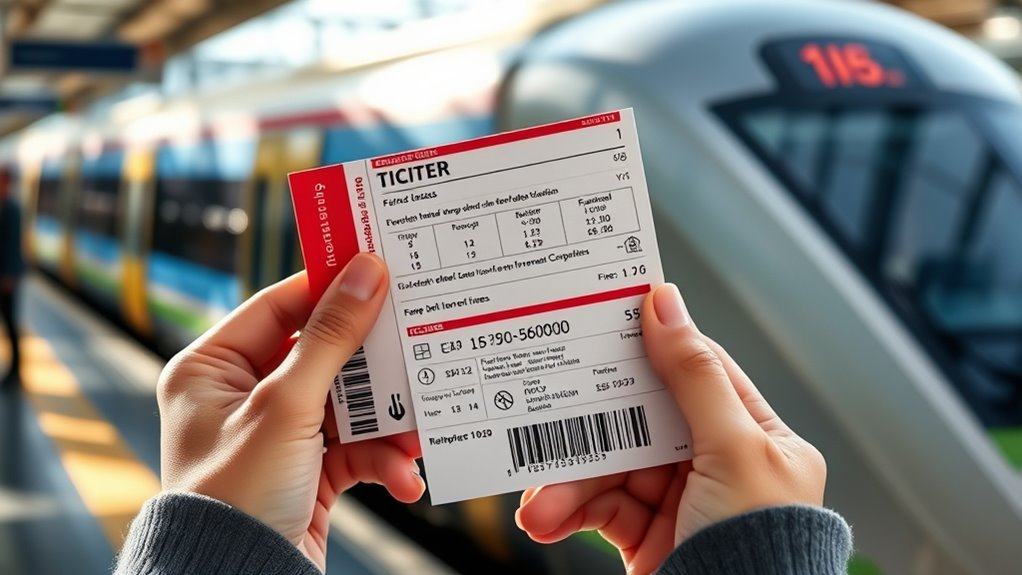
You need to check the fare rules and restrictions on your ticket to understand refund options and change policies. The class indicator tells you whether you’re traveling in first or second class, which affects comfort and price. Paying attention to these details helps guarantee your ticket matches your travel needs and flexibility. Being aware of fare classification can also help you choose the most suitable ticket type for your journey, especially when considering ticket washability and how it may impact your planning. Additionally, understanding reliable backup power options can ensure your travel plans are not disrupted by unexpected delays or emergencies. Familiarizing yourself with warranty considerations can also help you in case of reconditioning your travel equipment or devices during your trip.
Fare Rules and Refunds
Understanding fare rules and restrictions is essential for making informed travel decisions, as they determine your eligibility for refunds, exchanges, and upgrades. Your ticket will include specific conditions, such as non-refundable or partially refundable terms, especially on fixed, non-flexible fares. Check the fare code or class indicator to see if changes are allowed—flexible tickets often permit free or low-cost modifications, while advance or economy fares may be strict. Refunds usually require cancellation before a set deadline; late cancellations might incur fees or be rejected entirely. Some tickets specify restrictions like travel only on certain dates or trains, and others may restrict transferability. Always review these rules carefully to avoid unexpected costs or lost value, especially if your plans change.
Travel Class Indicators
Travel class indicators on European train tickets quickly reveal the fare conditions, restrictions, and level of comfort associated with your seat. Usually, you’ll see labels like “1st Class” or “2nd Class,” which indicate the travel experience you’ll receive. First class offers more spacious seats, quieter cabins, and additional amenities, while second class provides a more economical option with standard comfort. Sometimes, class information is shown as a code or letter, such as “F” for first class or “S” for standard, especially on regional or high-speed tickets. Pay attention to any notes about restrictions—some fares might be limited to specific classes or include access to exclusive lounges. Recognizing these indicators helps you select the right ticket for your comfort level and travel needs. Additionally, understanding train ticket terminology can help you interpret other important details like fare types and booking options. Being familiar with class labels and codes ensures you select the most suitable and comfortable travel option for your journey. For example, fare restrictions can vary widely depending on the class indicator and fare type selected, and noting the restrictions ensures you meet all conditions for your ticket. Moreover, understanding fare conditions can help you avoid surprises during your trip and choose the best options for your budget.
Identifying Pricing, Fare Codes, and Discount Labels

You’ll notice labels like “Standard” or “Semi-flexible” that show the fare type, revealing how flexible your ticket is and what refund options you have. Fare codes, often single letters or short combinations, identify the booking class and influence upgrade or change rules. Discount labels such as “25% youth” or “railcard” indicate savings, but you may need to carry a special card to qualify. Additionally, understanding environmental considerations can help you choose more sustainable travel options. Recognizing market trends in the Gold IRA sector can also inform your investment decisions and help you identify reputable providers like Noble Gold or Augusta Precious Metals. Being familiar with ticketing fundamentals ensures you make better-informed choices and avoid unexpected costs when traveling, including being aware of water in the wilderness concepts that can be crucial during journeys in remote areas.
Fare Type Labels
How can you quickly identify the ticket’s pricing and flexibility options? Look for the fare type label, which clearly states if it’s Standard, Semi-flexible, Fully-flexible, or Advance. This label reveals how much you can change or refund the ticket. Some tickets include a fare code—usually a letter or short code—that indicates the fare bucket and rules. Discount labels show if you qualify for youth, senior, or railcard discounts, often with percentage savings. These labels help you understand cost, flexibility, and eligibility at a glance.
| Fare Type | Description |
|---|---|
| Standard | Basic, non-flexible, usually cheapest |
| Semi-flexible | Limited changes, moderate refund options |
| Fully-flexible | Full flexibility, mostly refundable |
| Advance | Cheapest with strict change/refund rules |
Booking Class Codes
Booking class codes are essential for understanding the price, flexibility, and rules associated with your train ticket. These codes, often a single letter or short combination, indicate the fare bucket you’ve booked within the train operator’s pricing structure. They help determine upgrade options, change policies, and fare restrictions. For example, a “Y” might signify a standard second-class fare, while “S” could denote a semi-flexible ticket. Some operators also assign codes for discount fares, such as youth or senior discounts. Recognizing these codes enables you to compare options quickly and know what restrictions apply—like non-refundable or changeable conditions. Always check the fare code on your ticket to understand your booking’s flexibility, potential fees, and whether any discounts or special conditions are attached.
Discount Annotations
Discount annotations on train tickets reveal how much you save through special pricing or fare categories. Look for labels like “Youth,” “Senior,” or “Railcard” to identify discounts. Percentages such as “25%” or “50%” show the amount off the base fare, often requiring a valid discount card or proof. Sometimes, a specific fare code or letter indicates discounted fares—these can affect flexibility and change policies. Be aware that discounts may be limited to certain travel times, routes, or booking windows. Additional labels might specify savings for groups, families, or special passes. Always check if a separate discount card or voucher is needed to qualify. Recognizing these annotations helps you understand your fare’s value and avoid paying more than necessary.
Navigating Reservation Details, Supplements, and Ticket Validation
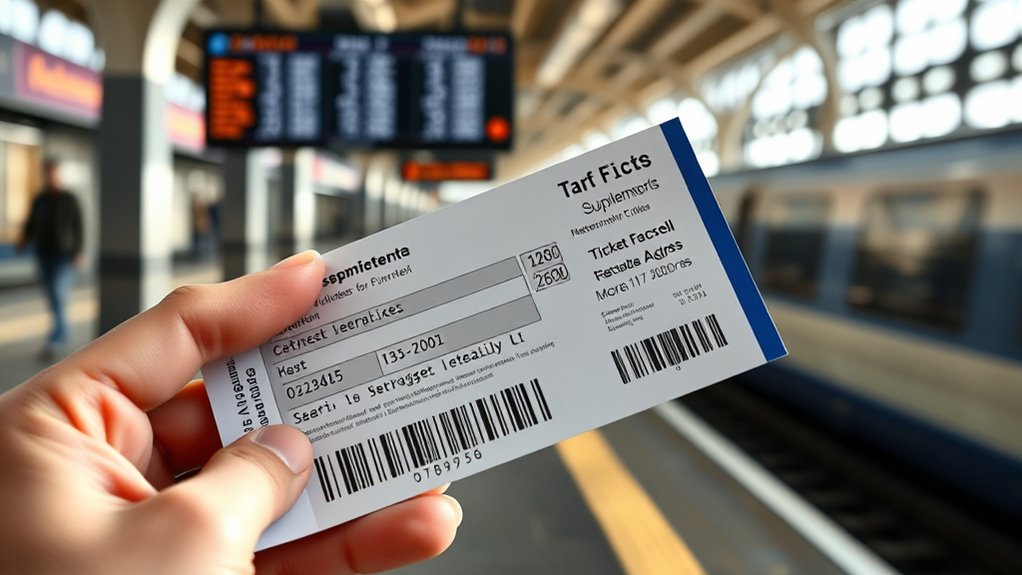
Understanding reservation details, supplements, and ticket validation is essential for a smooth journey. You need to interpret key information on your ticket to avoid delays or penalties.
Knowing how to read reservation details, supplements, and validation steps ensures a hassle-free train journey.
- Check the reservation line for train number, platform, coach, and seat; blank fields mean no seat reserved.
- Review any supplements listed for upgrades, bikes, or sleeper options; these may require separate payment or voucher.
- Confirm validation requirements, especially if your ticket needs stamping, or if you must collect a reservation at the station.
- For digital tickets, ensure the barcode or QR code is scannable and matches your ID if needed. On paper, print clearly and keep your ticket accessible.
Proper navigation of these details guarantees you board correctly and travel without surprises.
Frequently Asked Questions
How Do I Know if My Ticket Is Flexible or Non-Refundable?
You can tell if your ticket is flexible or non-refundable by checking the fare type label on the ticket. Flexible tickets are usually marked as “Semi-flexible” or “Fully-flexible,” meaning you can change or cancel with little or no fee. Non-refundable tickets often have labels like “Point-to-point” or “Advance,” and their conditions state no refunds or changes are allowed. Always review the fare conditions area for specific restrictions.
What Does the Fare Code or Booking Class Letter Signify?
Your fare code or booking class letter tells you how the ticket is priced and the flexibility it offers. It impacts whether you can change or cancel your reservation and if upgrades are available. Different letters or codes indicate various fare types—like economy, semi-flexible, or fully-flexible—so check the specific rules attached. Knowing this helps you choose the best ticket for your plans and understand any restrictions.
How Can I Tell if My Seat Reservation Is Confirmed or Pending?
You can tell if your seat reservation is confirmed or pending by checking the reservation details on your ticket. If the coach and seat number are printed clearly, your reservation is confirmed. If the fields are blank, marked as “TBC,” or say “Pending,” your seat isn’t guaranteed yet. Look for instructions like “Collect at station” or reservation reference codes to see if you need to finalize the booking.
Are Discounts Automatically Applied or Do I Need a Card?
You’ll want to make certain the discount is properly recognized on your ticket, as it often depends on showing your eligible card or documentation. While some discounts are automatically applied if your details are confirmed during booking, many require you to carry your discount card or proof to activate the reduction. Always double-check your ticket for the discount notation, and keep your card handy to avoid missing out on savings.
How Do I Verify if My Ticket Is Valid for Cross-Border Travel?
Check the ticket’s validity period and any specific operator or route restrictions. Look for mention of cross-border segments or multiple operator codes; these indicate it covers international travel. Verify if the ticket states “valid for all day” or has a start/end date fitting your journey. Also, review any notes about operator limits or special conditions for borders. If unsure, ask station staff or consult the operator’s website for confirmation.
Conclusion
Now that you know how to read European train tickets like a local, you’ll travel with confidence. Did you know that over 70% of travelers miss important fare details because they don’t understand the tickets? Mastering these tips guarantees you avoid surprises and get the best deals. So, next time you board a train, you’ll read your ticket effortlessly and enjoy your journey with peace of mind. Happy travels!