
In Europe, trains often save you time on short to medium routes—especially when stations are centrally located and security checks are quick—making door-to-door travel faster than flights. For longer journeys over five hours, flights usually come out ahead due to faster in-vehicle times and less impact from delays. If you want details on how distance, infrastructure, and schedules influence travel speed, there’s more to explore.
Key Takeaways
- Trains often save time for trips under 250 km due to quick access and minimal security checks.
- Flights are faster for long distances (> 5 hours) thanks to higher cruising speeds and direct routes.
- Central train stations reduce total travel time, especially for short to medium routes, compared to airport transfers.
- Schedule reliability favors trains over flights, which are more susceptible to weather and air traffic delays.
- Overall, trains excel in shorter, city-to-city trips, while flights are more time-efficient on extensive, long-haul routes.

Italy Train Guide 2025: Routes, Tickets, and Tips for Exploring Italy by Rail
As an affiliate, we earn on qualifying purchases.
As an affiliate, we earn on qualifying purchases.
Short-Distance Routes: When Trains Outpace Flights

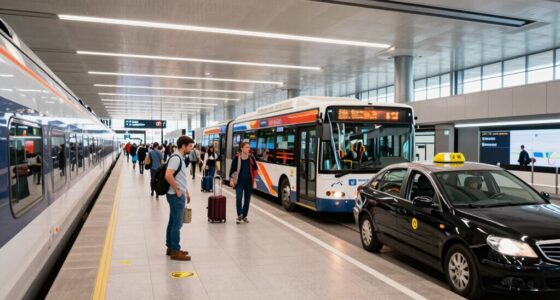
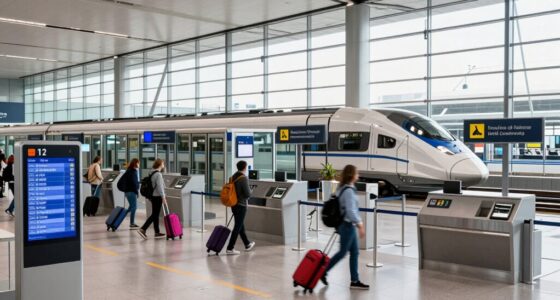
When traveling short distances—typically up to 200–250 km—trains often beat flights in total travel time because they are faster door-to-door. Station locations are centrally integrated, meaning you spend less time accessing the train and boarding quickly. Unlike airports, which require long security checks and check-in buffers, trains usually take just minutes to board. Schedule frequency also plays a role; high-frequency trains reduce waiting times, making your journey more predictable. Because of shorter access and boarding times, trains often outperform flights in total duration, especially on city pairs under a couple of hours. Additionally, high-quality projectors with fast setup and quick image calibration can further reduce overall travel and setup time, making trains the smarter choice for short trips, saving you time and hassle compared to flying. Furthermore, understanding free floating transit options can help optimize your travel plans by offering more flexible schedules and routes. Exploring real-time transit updates can also help you avoid delays and choose the most efficient travel options. Incorporating integrated ticketing systems can streamline the boarding process and further minimize delays. Moreover, considering the principles of efficiency from urban transit planning can enhance your travel experience by reducing unnecessary stops and detours.

LUGGEX Underseat Carry On Luggage with Wheels, UDK Stylish Lightweight Under Seat Luggage, Soft Sided Personal Item Suitcase for Short Trip (UX-Core, Dark Scarlet, 16 Inch)
Airline Approved: The rolling underseat bag (15.7"x13"x7.7") meets most airlines' size requirements, fitting perfectly under the seat or…
As an affiliate, we earn on qualifying purchases.
As an affiliate, we earn on qualifying purchases.
Medium Distances: The Race for Time Parity
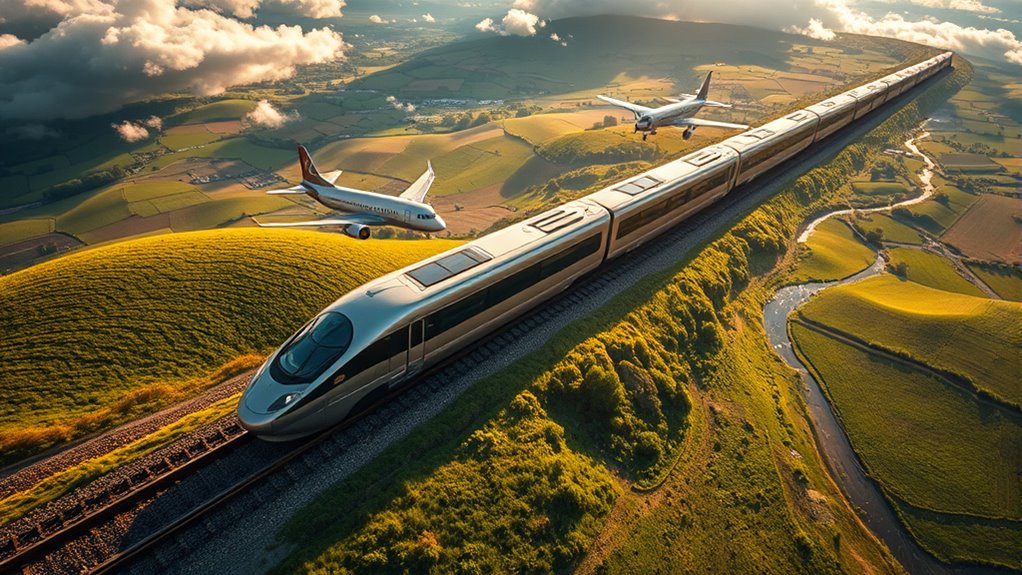
At medium distances, you’ll find that total travel times for trains and flights often match when you include access, security, and transfer times. Schedule reliability plays a big role, with trains offering more consistent departures and arrivals compared to often-delayed flights. Transfers and airport access can tip the balance, making trains more attractive when stations are centrally located and direct routes are available. Additionally, European energy-efficient cloud servers exemplify how sustainable infrastructure supports efficient operations, just as optimized transportation networks enhance travel efficiency. Incorporating auditory processing skills into planning can also streamline decision-making and improve overall travel experience, especially for travelers with specific sensory sensitivities. Recognizing the importance of passive voice detection can further refine travel writing by making descriptions clearer and more engaging for readers. Moreover, understanding schedule adherence helps travelers choose options that best suit their time constraints and reduce stress.
Total Travel Time Balance
In the domain of medium-distance travel, the battle for time parity hinges on how quickly you can get from door to door once you factor in all stages of the journey. For trips under three hours, trains often win because station locations are central, boarding is quick, and security checks are minimal. Once travel extends to 2–5 hours, total times for trains and flights often align when you include airport transfers, check-in, and security. Flights tend to dominate on routes longer than five hours, as in-vehicle rail time becomes less competitive. Factors like direct routes, station proximity, and schedule frequency heavily influence the balance. Ultimately, your choice depends on how these variables stack up for each specific route, affecting your total travel time more than the nominal journey duration.
Schedule Reliability Factors
Schedule reliability plays a key role in determining whether trains or flights come out ahead in medium-distance travel. You’ll find trains often more dependable because they face fewer disruptions from weather and air traffic control issues. High-speed rail networks with dedicated lines tend to run on time more consistently, especially when infrastructure is well-maintained. Conversely, flights are vulnerable to delays caused by weather, airspace congestion, and technical issues, which can cascade into longer wait times. Transfers also impact reliability; direct train routes with frequent departures reduce the chance of missed connections. Additionally, border controls within the Schengen Area rarely cause delays for trains, unlike flights, which often face longer security checks and customs procedures. Connected technology in modern trains further enhances schedule reliability by providing real-time updates and automated signaling, helping operators respond swiftly to minor disruptions. Moreover, the reliability of rail schedules is often improved by dedicated high-speed lines that minimize interference from other traffic. The integration of advanced signaling systems and infrastructure maintenance practices further boosts punctuality. External factors such as weather conditions can still influence train punctuality, but overall, the controlled environment of rail networks provides a more consistent schedule. Additionally, ongoing infrastructure investments contribute to maintaining and improving schedule reliability over time. Overall, trains generally offer more predictable schedules, helping you plan your journey more confidently.
Transfer and Access Impact
Transfer and access times often tip the balance between trains and flights at medium distances. You’ll find that train stations are usually centrally located, making access quick and straightforward, often shaving minutes from your total travel time. In contrast, airports tend to be farther from city centers, requiring additional transit, which can add 30 minutes or more. Boarding a train takes just minutes, whereas airport check-in, security, and baggage procedures can take an hour or more. High-speed rail lines with direct routes and frequent departures reduce waiting times, making train travel more convenient. Conversely, flights often involve longer pre-departure buffers and transfer times at peripheral airports. Overall, how easily you can access your departure and arrival points considerably influences whether trains or flights save you time on medium-distance trips. Additionally, efficient access techniques highlight the importance of efficiency and self-sufficiency, which can also be a consideration for travelers seeking independence during their journeys. Implementing optimized scheduling and real-time updates further enhances the overall travel experience, ensuring minimal delays and smoother connections. Incorporating reliable transportation networks can further optimize your travel time and overall experience.

Soundcore by Anker Q20i Hybrid Active Noise Cancelling Headphones, Wireless Over-Ear Bluetooth, 40H Long ANC Playtime, Hi-Res Audio, Big Bass, Customize via an App, Transparency Mode (Black)
Hybrid Active Noise Cancelling: 2 internal and 2 external mics work in tandem to detect external noise and…
As an affiliate, we earn on qualifying purchases.
As an affiliate, we earn on qualifying purchases.
Long-Haul Journeys: Why Flights Usually Win
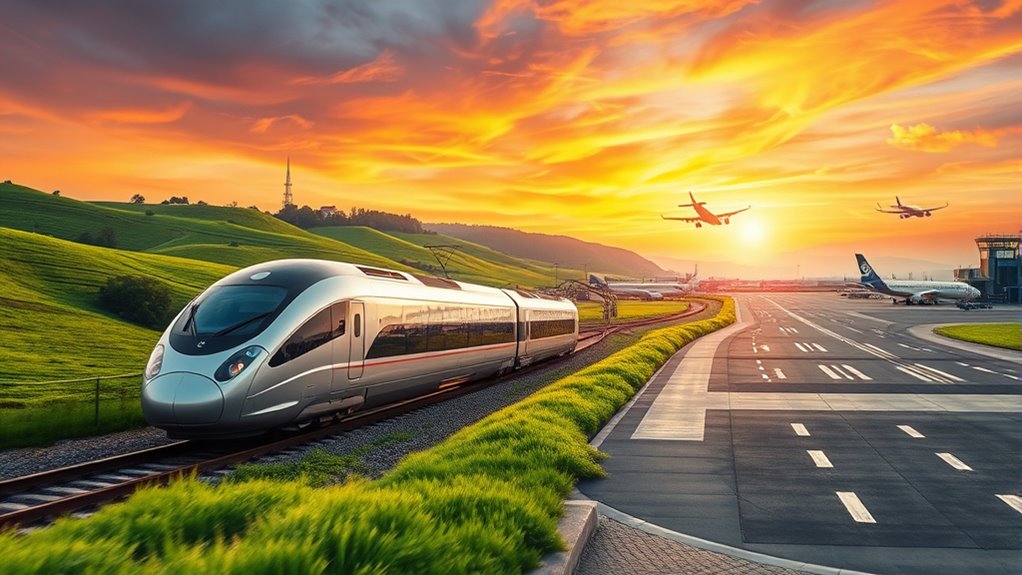
When traveling long distances, flights often win because in-vehicle time becomes the main factor, and trains simply can’t keep up. Infrastructure constraints, like limited high-speed rail networks and direct routes, make it hard for trains to compete with the speed of air travel. As a result, flying usually offers the quickest door-to-door option for these journeys.
In-Vehicle Time Dominance
On long-haul journeys, flights typically dominate because the in-vehicle time—the actual time spent traveling—is much shorter than on trains. Airplanes cover vast distances quickly, while trains require hours of steady movement. Once airborne, you’re often cruising for several hours with minimal stops, making the flight faster than a train that takes longer to traverse the same route. Even with some airport delays, the overall travel time remains shorter than a train’s lengthy journey. Night flights can be even more efficient, letting you sleep through the trip. In contrast, trains on long routes have extended in-vehicle times that often outweigh any convenience benefits. As a result, flying becomes the preferred option for speed on long-distance European travel.
Infrastructure Constraints
Long-haul rail routes are limited by infrastructure constraints that make flights more practical for covering extensive distances quickly. High-speed rail networks require costly and time-consuming construction of dedicated tracks, which aren’t always available or feasible over long corridors. Limited direct high-speed links mean many routes involve transfers or indirect paths, adding delays. Rail infrastructure also faces speed restrictions due to existing track conditions, urban areas, and safety regulations. In contrast, airlines benefit from extensive, established networks with frequent, direct flights connecting major airports. While high-speed trains excel over short and medium distances, rail network limitations on long routes hinder their competitiveness. Infrastructure constraints such as aging tracks and urban development further impact the overall efficiency of train travel over extensive distances. As a result, flights often remain the fastest and most convenient option for long-haul journeys across Europe.

INIU Portable Charger, Ultra Slim 45W Fast Charging with Attached USB C Cable, Flight-Safe 10000mAh PD Power Bank Battery Pack, Travel Essential Phone Powerbank for iPhone 17 16 Samsung S25 Google etc
From INIU–the SAFE Fast Charge Pro: Experience the safest charging with over 38 million global users. At INIU,…
As an affiliate, we earn on qualifying purchases.
As an affiliate, we earn on qualifying purchases.
Station and Airport Locations: Proximity as a Time Factor
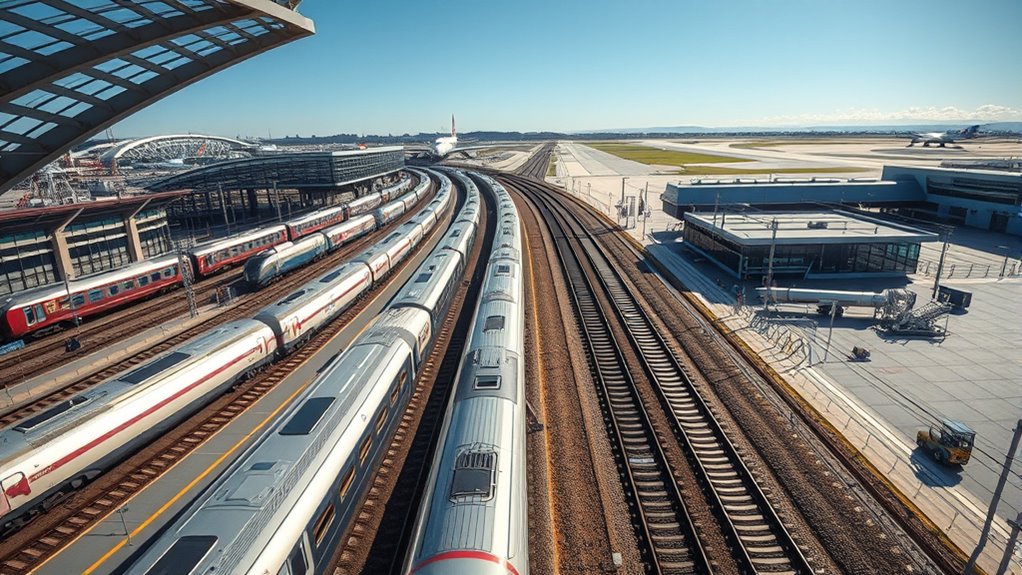
The proximity of stations and airports considerably influences overall travel time, often tipping the balance between trains and flights. If your station is centrally located, you’ll spend less time reaching your departure point, making train journeys faster overall, especially for short distances. Conversely, airports situated on the outskirts increase access time, which can outweigh the in-vehicle time advantage of flying. High-speed rail stations often connect directly to city centers, reducing transfer delays. Airports with extensive shuttle services or distant locations add to total travel duration. For routes under 200–250 km, central train stations typically provide quicker door-to-door journeys, while longer distances may favor flights when airport transit time becomes significant. Additionally, station and airport locations are key factors in determining the fastest travel option. Understanding station and airport locations can help travelers make more informed choices for time-efficient journeys. Furthermore, transit connectivity plays a crucial role in minimizing total travel time by ensuring smooth transfers between different transportation modes. When considering travel options, evaluating accessibility and local transportation infrastructure can further optimize your overall journey duration.
Cost and Scheduling: How Pricing Influences Travel Time Choices
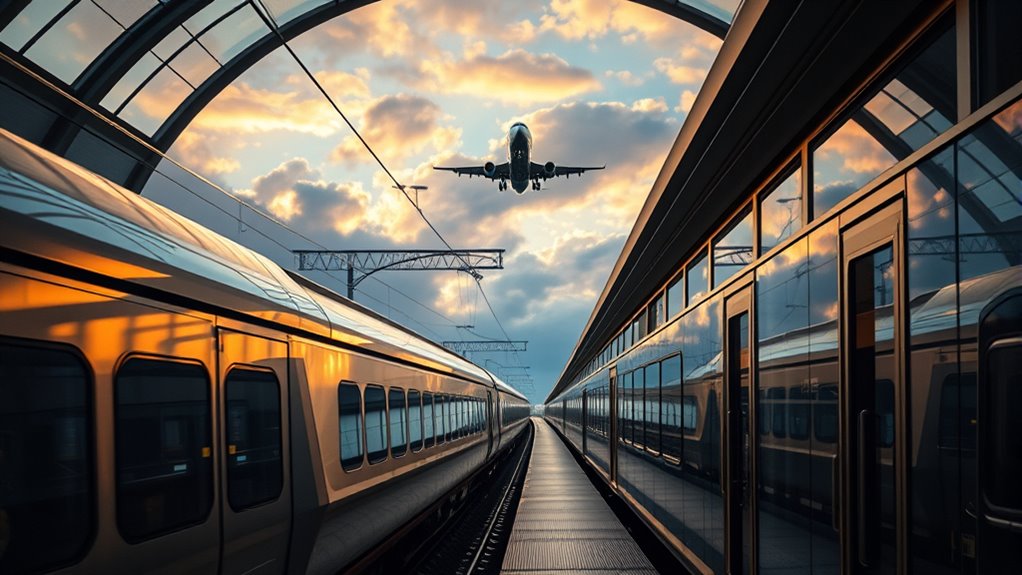
Pricing plays a pivotal role in shaping your choice between trains and flights, often overriding time considerations. Low-cost airlines frequently offer cheaper fares, making flying attractive even when total travel time is similar or slightly longer. Advanced booking discounts and dynamic pricing can make flights considerably cheaper than last-minute train tickets, especially on popular routes. On shorter and medium routes, airport buffers like security checks, transfers, and check-in add fixed time costs that can make flying less time-efficient despite lower prices. Conversely, trains often provide more predictable costs and flexible schedules, reducing uncertainty. If your priority is budget, you might choose a flight, even if it’s not the fastest. But for convenience and certainty, the slightly higher train fare may be worth the time saved. Travel time efficiency can also be influenced by the choice of transportation, with trains often offering shorter, more direct routes in densely populated regions. Additionally, transportation infrastructure quality can significantly impact overall travel times, making some routes faster by train than by air depending on station locations and rail network coverage.
Reliability and Experience: Beyond Just Speed
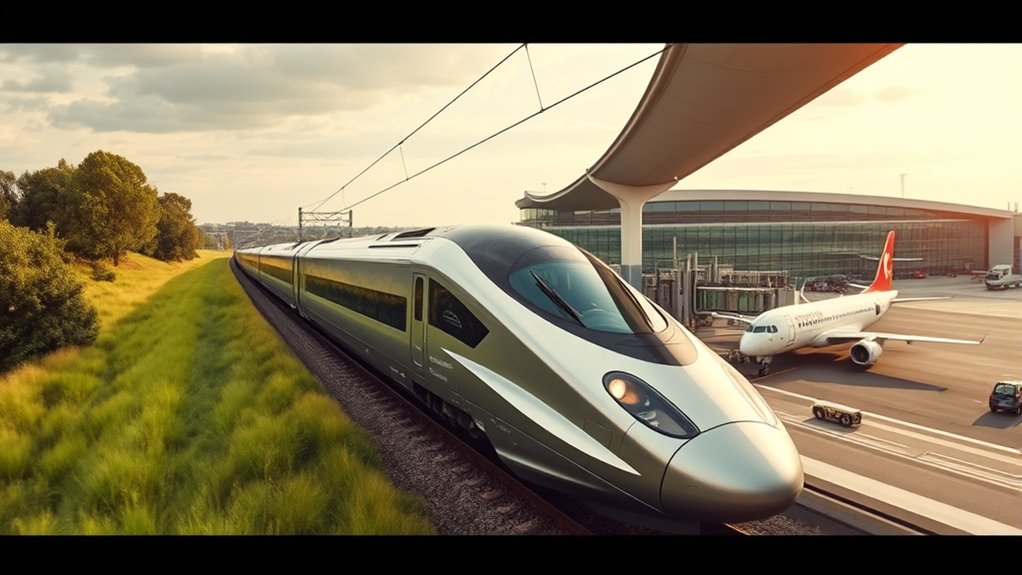
Reliability often influences your overall travel experience more than speed alone, as unpredictable delays can substantially disrupt plans. With trains, delays tend to be fewer and more predictable, giving you confidence in arrival times. The onboard experience also matters: trains offer smoother journeys, Wi-Fi, and space to work or relax, making time feel more productive. Conversely, flights face weather, air traffic control, and security issues, increasing schedule uncertainty.
| Aspect | Train | Flight | Notes |
|---|---|---|---|
| Delay Frequency | Less frequent, predictable | More frequent, variable | Trains often provide more consistent timing. |
| Onboard Comfort | Spacious, Wi-Fi, work space | Limited, security checks | Comfort enhances perceived reliability. |
| Urban Access | Central stations | Peripheral airports | Closer to city centers reduces travel stress. |
Frequently Asked Questions
How Does Train Station Location Impact Overall Travel Time Compared to Airports?
Your overall travel time is greatly affected by station location. If the train station is centrally situated, you save time on access and transfers, making your journey faster. Conversely, if the airport is far from the city center, you spend more time reaching it, adding delays. Choose routes with conveniently located stations to minimize total travel time, especially on short and medium-distance trips where station proximity makes a big difference.
Do High-Speed Rail Lines Significantly Reduce Travel Time on Medium-Distance Routes?
High-speed rail lines can cut travel time by up to 50% on medium-distance routes, making journeys under 3 hours often faster than flying. You’ll benefit from fewer delays, quick boarding, and city-center stations, reducing overall transit. For example, trips like Paris to Brussels now take less than two hours by train, rivaling flight times when you factor in airport check-ins and transfers. This efficiency makes high-speed rail a smart choice for medium distances.
How Do Delays and Cancellations Differ Between Trains and Flights in Europe?
You’ll find that delays and cancellations happen more frequently with flights in Europe, mainly due to weather, air traffic, or technical issues. Trains tend to be more reliable because they operate on fixed schedules and are less affected by weather. When disruptions occur, train delays are usually shorter and easier to manage, while flight cancellations often cause more significant delays, requiring longer rebooking or waiting times.
Can Night Trains Replace Short Flights for Time Efficiency and Comfort?
Night trains can replace short flights efficiently and comfortably, especially if you value saving daytime hours and avoiding airport hassles. You sleep while traveling, which maximizes your time at the destination. Plus, night trains often offer cozy sleeping cabins and onboard amenities that enhance comfort. However, they might take longer than quick flights, so if time is your top priority, flying still holds an edge on some routes.
How Do Ticket Prices and Booking Strategies Influence Total Travel Time Decisions?
Your ticket prices and booking strategies directly impact your total travel time decisions. If you find low-cost fares or book early, you can save money and sometimes time, especially with advance discounts on flights. Last-minute bookings often mean longer wait times and higher prices, making trains more attractive for short to medium trips. Flexible booking options and choosing off-peak times help you minimize delays and optimize your overall travel schedule.
Conclusion
So, whether you choose the swift elegance of trains or the soaring speed of flights, remember—your choice could mean the difference between arriving in minutes or feeling like you’ve traveled through time itself. In Europe’s vast travel tapestry, every second counts, and your decision might just turn a quick trip into a legendary adventure—or an epic saga. Pick wisely, because in this race against the clock, there’s no telling how far your journey might stretch!