

Weather forecasts about rain involve complex models that analyze atmospheric data and predict probabilities, which can feel uncertain or inconsistent. Small-scale changes like microclimates and regional features can cause forecast differences even within short distances. Longer-term predictions are less reliable due to shifting climate patterns and oscillations. By understanding how models assess uncertainty and improve with technology, you’ll see why ‘chance of rain’ might seem different each time—more details await if you continue exploring.
Key Takeaways
- Probabilistic forecasts indicate varying likelihoods, making “chance of rain” feel uncertain and unpredictable in daily experience.
- Local microclimates and terrain cause small-scale weather changes, affecting how rain chances are perceived locally.
- Short-term forecasts are more accurate, but perception of rain can differ based on sudden weather shifts not captured in predictions.
- Regional and seasonal factors influence forecast confidence, making “chance” feel more or less reliable depending on context.
- Effective communication of probability helps manage expectations, but individual experiences often feel more uncertain than numerical odds.

AcuRite Wireless Rain Gauge with Self-Emptying Rain Collector with Rainfall History, Alerts, and Current Date and Time (02446M)
Outdoor rain collector measures rainfall in your backyard and wirelessly transmits readings to its indoor display
As an affiliate, we earn on qualifying purchases.
As an affiliate, we earn on qualifying purchases.
The Science Behind Rain Probability Predictions
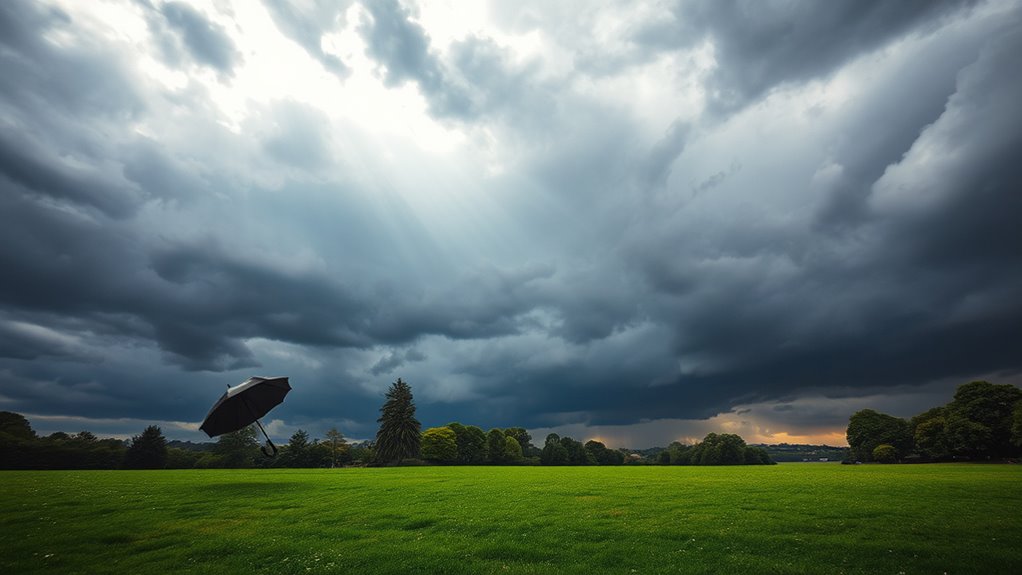
Rain probability predictions rely on sophisticated meteorological models that analyze current atmospheric conditions to estimate the likelihood of rainfall. These models gather data from satellites, weather stations, and radar to assess variables like humidity, temperature, wind patterns, and air pressure. By inputting this information into complex algorithms, meteorologists generate probability forecasts, often expressed as percentages. For example, a 70% chance indicates a high likelihood of rain based on current conditions. Additionally, ensemble forecasting runs multiple simulations with slight variations in data, helping to gauge uncertainty and refine predictions. Modern forecasting techniques incorporate cloud computing and advanced algorithms to deliver more accurate and timely rain forecasts, helping you plan your day and make informed decisions about outdoor activities or travel.

Midland – ER310, Emergency Crank Weather AM/FM Radio – Multiple Power Sources, SOS Emergency Flashlight, Ultrasonic Dog Whistle, & NOAA Weather Scan + Alert (Red/Black)
MULTIPLE POWER SOURCES – The ER310 features 3 sustainable power sources to recharge your radio: Solar Panel, Hand…
As an affiliate, we earn on qualifying purchases.
As an affiliate, we earn on qualifying purchases.
Understanding the Range of Forecast Accuracy

Understanding the range of forecast accuracy helps you gauge how reliable weather predictions are over different timeframes. For example, a 1-day maximum temperature forecast is about 92% precise, giving you confidence in short-term predictions. However, accuracy drops as the forecast extends; a 5-day maximum temperature forecast is around 75% dependable, meaning you should interpret it with some caution. Wind forecasts also vary: within 22.5 degrees, they’re 57% accurate over five days. These figures show that short-term forecasts generally provide more certainty, while longer-term predictions carry more uncertainty. Recognizing this range helps you plan better, understanding that weather forecasts become less exact as the timeframe extends. Monitoring ongoing forecast accuracy metrics ensures you stay informed about forecast reliability over different periods. Additionally, different projection technologies, such as color accuracy and contrast ratios, influence how clearly weather visuals are displayed in digital forecasts, impacting how easily you can interpret forecast data. Being aware of forecast confidence levels can further help you decide how much trust to place in the predictions. When considering forecast reliability, it’s helpful to understand the underlying model performance and how it varies across regions and seasons.

Newentor Weather Station Wireless Indoor Outdoor Thermometer, Color Display Digital Weather Thermometer with Atomic Clock, Barometric Pressure, Forecast Station with Adjustable Backlight, Black
[7.5" LCD Screen Weather Stations] Newentor temperature&humidity monitor with large color display, which shows comprehensive information: inside outside…
As an affiliate, we earn on qualifying purchases.
As an affiliate, we earn on qualifying purchases.
How Small-Scale Weather Changes Impact Daily Forecasts

Small-scale weather changes, such as local temperature variations, sudden wind shifts, or brief cloud formations, considerably influence daily forecasts‘ accuracy. These small fluctuations can cause forecast models to struggle with pinpointing exact conditions, especially in regions with complex terrains or coastal areas. For example, a sudden wind shift might alter cloud movement, impacting rain predictions. Temperature variations in a localized area can lead to errors in high or low forecasts. Additionally, microclimate effects can create significant discrepancies between forecasted and actual weather conditions. These effects are often influenced by geographical features, which can cause localized deviations from general regional forecasts. Although modern models incorporate high-resolution data, these rapid, small-scale changes still challenge forecast precision. Furthermore, the dynamic nature of weather systems means that even small shifts can have larger implications for the day’s weather. You might notice the forecast differs from actual conditions due to these micro-level shifts. Meteorologists continuously refine their methods to better capture these nuances, but small-scale weather remains a key factor in the inherent uncertainty of daily weather predictions. Enhanced forecasting techniques are helping meteorologists improve accuracy despite these challenges.

Portable Agricultural Weather Monitor with Microclimate Information Collector System
As an affiliate, we earn on qualifying purchases.
As an affiliate, we earn on qualifying purchases.
Variations in Forecasts Over Short and Long Lead Times

You notice that short-term forecasts, like for tomorrow, are highly accurate, but this accuracy drops considerably as the forecast extends to five or more days. This variation occurs because predicting weather becomes more uncertain over longer periods, especially with regional differences. Understanding these limitations helps you better interpret forecast reliability across different timeframes and areas. Additionally, incorporating up-to-date meteorological data into forecasts can improve their accuracy and help manage expectations. Recognizing the influence of weather forecast models can further clarify why predictions vary over time. Factors such as model accuracy and the inherent unpredictability of atmospheric systems also play significant roles in forecast variability over extended periods.
Short-Term Forecast Accuracy
Forecast accuracy in the UK varies markedly depending on the lead time. For short-term forecasts, like one day ahead, you’ll find high reliability—around 92% for maximum temperature and 89% for minimum temperature. Wind direction forecasts within 22.5 degrees reach about 57% accuracy over five days, showing more variability. These short-term predictions are crucial for daily planning and often meet the standards of good accuracy, especially when predicting temperature during heatwaves. You can generally trust the forecast for the next 24 hours, but as the lead time increases, accuracy drops—especially for wind speed and longer-range predictions. Monitoring systems track these performance metrics in near real-time, helping meteorologists refine their models and keep you better informed. Additionally, understanding forecast variability can help manage expectations and improve preparedness for changing weather patterns. It is also important to consider model limitations that can affect forecast precision over extended periods. Recognizing the impact of atmospheric conditions further aids in interpreting forecast reliability and refining predictive models. Moreover, the integration of real-time data from various sources enhances forecast accuracy, especially in unpredictable weather scenarios.
Long-Term Prediction Challenges
Long-term weather predictions in the UK face significant challenges because the factors influencing climate patterns are more complex and less predictable than those affecting short-term forecasts. Over days or weeks, small shifts in ocean currents, atmospheric pressure, or jet streams can drastically alter outcomes. As a result, forecast accuracy drops noticeably with increased lead time.
| Forecast Horizon | Accuracy Level | Key Challenge |
|---|---|---|
| 1-2 days | Very high | Limited variability |
| 3-7 days | Moderate | Small-scale influences |
| 8-14 days | Low | Large-scale pattern shifts |
| 15-30 days | Unreliable | Unpredictable climate oscillations |
| 1+ months | Very uncertain | Complex climate interactions |
This table highlights how prediction reliability diminishes over longer periods, making long-term forecasts inherently more uncertain.
Variability Across Regions
Regional weather forecasts in the UK can vary greatly over both short and long lead times, reflecting the complex interactions of local geography, atmospheric conditions, and oceanic influences. For example, wind speed accuracy ranges from 71% in the Irish Sea to 89% in Sole, while wind direction accuracy varies from 84% along the Tyne to 94% near Fitzroy. Short-term forecasts, like one-day predictions, tend to be more accurate—up to 92% for maximum temperatures—yet longer-term outlooks, such as seven-day forecasts, see errors rise to nearly 929 MW. This variability is influenced by regional differences in topography and sea conditions, making it challenging to predict precisely across the country. Continuous monitoring and regional calibration help improve these forecasts, but inherent local differences still create notable variations.
The Role of Ensemble Models in Improving Rain Predictions

Ensemble models help you better understand the uncertainty in rain forecasts by running multiple simulations with slight variations in data. This approach improves forecast reliability by showing a range of possible outcomes, so you can prepare more effectively. By quantifying prediction uncertainty, ensemble models make rain predictions more accurate and trustworthy.
Quantifying Prediction Uncertainty
Ensemble models play a crucial role in quantifying prediction uncertainty for rain forecasts by running multiple simulations with slight variations in initial conditions. This approach helps you understand the range of possible outcomes and improves forecast reliability. By analyzing the variation across simulations, you can identify areas with higher uncertainty and better communicate forecast confidence. To deepen your understanding, consider these key points:
- They generate a spectrum of potential scenarios, highlighting best- and worst-case outcomes.
- They reduce errors by averaging multiple runs, smoothing out anomalies.
- They identify regions where predictions are less certain, guiding decision-making.
- They support continuous model refinement through ongoing comparison with observed data.
This methodology enhances your ability to interpret rain forecasts, making them more actionable and trustworthy.
Enhancing Forecast Reliability
To improve rain forecast reliability, meteorologists increasingly rely on ensemble models that run multiple simulations with slight variations in initial conditions. This approach helps capture the range of possible outcomes, reducing the uncertainty inherent in single-model predictions. By analyzing these multiple runs, you can better gauge the likelihood of rain and its intensity. Ensemble models improve accuracy by averaging results and identifying outliers, which are then adjusted or discarded. The UKV regional model, for example, benefits from ensemble techniques, providing higher-resolution, more reliable forecasts. This method allows you to see the probability of rain over different areas and times, making your weather predictions more trustworthy. Overall, ensemble modeling enhances forecast confidence, especially for short-term rain predictions, helping you plan better.
Regional Differences in Rain Forecasting Performance

Regional differences markedly impact rain forecasting performance across the UK. You’ll notice that accuracy varies considerably depending on location. For example:
- Coastal areas like the west and southwest often see better forecast accuracy due to clearer weather patterns.
- Urban regions face challenges from microclimates, reducing forecast precision.
- Mountainous zones introduce complex weather systems, lowering prediction reliability.
- The east and inland areas typically experience more variability, making rain forecasts less consistent.
These disparities arise from factors like terrain, proximity to water, and local microclimates. As a result, your experience of “chance of rain” can feel quite different depending on where you are in the UK. Understanding these regional differences helps you interpret forecasts more accurately and manage expectations.
Monitoring and Verifying Rain Forecasts in Real Time

Monitoring and verifying rain forecasts in real time is essential for guaranteeing accuracy and building trust in weather predictions. You need to compare forecasts with observations from multiple UK sites to identify discrepancies quickly. Near-real-time data allows you to spot trends, such as forecast overestimations or underestimations, and adjust models accordingly. Automated anomaly detection filters out outliers that could skew results, maintaining data integrity. Seasonal adjustments help account for typical variance spikes, ensuring your verification remains relevant. By continuously evaluating performance across diverse regions, you can refine models and improve reliability. Incorporating weather data validation techniques ensures that your assessments are precise and trustworthy. Implementing these verification methods helps maintain high standards of forecast accuracy over time. This ongoing process ensures predictions stay current and precise, which is crucial for informing daily decisions and managing weather-related risks effectively. Additionally, understanding the Gold IRA Markets can influence financial planning strategies related to weather-sensitive investments. Recognizing cultural symbols for strength can inspire resilience in the face of unpredictable weather patterns, strengthening community preparedness efforts.
Furthermore, adopting a methodical approach to data collection and analysis ensures consistency and enhances the overall robustness of your verification process.
The Influence of Climate Patterns on Rain-Related Uncertainty

Climate variability shapes the unpredictability of rain in the UK, making forecasts more challenging. Seasonal patterns and shifting climate trends introduce uncertainties that complicate prediction models. Additionally, small-scale weather events often cause sudden changes, increasing rain-related uncertainty in your forecasts. Recognizing Serat Nest phenomena can help explain some of these unpredictable weather patterns.
Climate Variability Impacts
Climate variability plays a significant role in rain-related forecast uncertainty, as shifting patterns influence both the location and intensity of precipitation events. Unpredictable changes in atmospheric conditions make it harder to pinpoint exactly when and where rain will fall. This variability stems from factors like jet stream fluctuations, oceanic cycles, and changing sea surface temperatures. These elements create a dynamic environment that complicates forecasts, especially over longer periods. To better understand these impacts, consider:
- The influence of oceanic cycles like the North Atlantic Oscillation on rainfall patterns.
- How jet stream shifts alter storm tracks and precipitation zones.
- The effect of sea surface temperature changes on localized rainfall intensity.
- The increased difficulty in predicting small-scale weather events amid broad climate fluctuations.
These factors combine to heighten rain forecast uncertainty, making precise predictions more challenging.
Seasonal Prediction Challenges
Seasonal prediction challenges arise because large-scale climate patterns exert a strong influence on rainfall variability over extended periods, making it harder to forecast precipitation accurately months in advance. These patterns, like the North Atlantic Oscillation or El Niño, can shift rainfall patterns unpredictably, adding uncertainty to long-term forecasts. Unlike daily or weekly predictions, where models can rely on recent data, seasonal forecasts depend on complex interactions that evolve slowly. Small changes in these climate drivers can lead to significant differences in rainfall outcomes. As a result, you face inherent limits in predicting whether a summer or winter will be wetter or drier than usual. This variability underscores why seasonal rainfall expectations often come with wide margins of error, complicating planning and decision-making.
Small-Scale Weather Effects
Small-scale weather events considerably increase forecasting uncertainty because they can change rapidly and are influenced by local factors that broader climate patterns might not predict accurately. These tiny shifts can dramatically alter rain chances, making precise predictions challenging. To understand this, consider:
- Local topography affecting rainfall distribution.
- Microclimates creating isolated weather variations.
- Small-scale atmospheric disturbances that bypass larger patterns.
- Rapid changes in temperature and humidity influencing precipitation onset.
Because these effects occur on a limited spatial scale, they’re harder to model reliably. Even with advanced tools like regional high-resolution models, the unpredictability persists. Recognizing these small-scale influences helps you grasp why rain forecasts sometimes feel uncertain, despite overall climate trends providing a broader picture.
Communicating Uncertainty to the Public Effectively

How can weather forecasters share uncertainty without confusing or alarming the public? The key is clear, honest communication. Instead of presenting forecasts as absolute, explain the range of possible outcomes, like “There’s a 70% chance of rain,” or “Temperatures could vary by a few degrees.” Use visuals, such as probability maps or confidence intervals, to help people grasp uncertainty visually. Avoid technical jargon and focus on what the forecast means for daily plans. Emphasize that forecasts improve over time, but some variability remains. By framing uncertainty as part of the weather’s natural variability, you build trust and reduce misinterpretation or panic. Effective communication means helping people make informed decisions, not hiding the inherent unpredictability of weather.
Future Innovations in Weather Prediction Technologies

Advancements in weather prediction technologies are transforming how forecasts are generated and communicated, aiming to improve accuracy and reliability. These innovations focus on leveraging cutting-edge tools to refine predictions and better serve the public.
- Ensemble forecasting uses multiple simulations to reduce errors and quantify uncertainty, providing a range of possible outcomes.
- High-resolution regional models like UKV offer detailed forecasts, especially for small-scale weather phenomena.
- Real-time monitoring systems continuously assess forecast performance, enabling swift adjustments and validation.
- Artificial intelligence and machine learning analyze vast datasets, identifying patterns to enhance prediction precision, especially for heatwaves and localized events.
Together, these innovations will make weather forecasts more accurate, timely, and trustworthy, helping you adapt better to changing conditions.
Frequently Asked Questions
How Does Regional Topography Affect Rain Forecast Accuracy?
Regional topography markedly impacts your rain forecast accuracy because mountains, valleys, and coastlines influence how weather systems develop and move. When you’re in hilly or mountainous areas, forecasts may be less precise due to complex airflow and localized weather patterns. Conversely, flatter regions allow for more straightforward predictions. Your local terrain can cause rain to fall unexpectedly or miss predicted areas, making forecasts more challenging and less reliable in diverse topographies.
What Are the Main Challenges in Predicting Sudden Rain Showers?
Predicting sudden rain showers is a real challenge, isn’t it? Ironically, the very unpredictability of small-scale weather makes it tough to forecast accurately. You might check the forecast, only to get caught in a surprise downpour. Rapid changes in wind, temperature, and humidity happen too quickly for models to keep up, especially without clear global drivers. That’s why sudden showers often feel like weather’s little joke.
How Does Climate Change Influence Rain Forecast Reliability?
Climate change makes rain forecast reliability trickier because it increases the frequency and intensity of sudden weather changes. You’ll notice more unpredictable rain showers, as small-scale weather impacts become more common. While forecasting models have improved, these rapid shifts challenge accuracy. So, expect some variability in predictions, especially during heatwaves or storms, since the changing climate adds complexity to what once was more predictable weather patterns.
Why Do Forecast Errors Increase With Longer Lead Times?
Forecast errors increase with longer lead times because weather systems become more complex and harder to predict accurately over time. As you look further ahead, small uncertainties and small-scale impacts, like local temperature shifts or wind changes, amplify, making forecasts less reliable. Even with advanced models and ensemble methods, the inherent chaos of weather means you’ll see higher inaccuracies in 7-day forecasts compared to 1-day predictions.
How Can Public Understanding of Forecast Uncertainty Be Improved?
Think of weather forecasts as a compass in fog—you need to see the horizon clearly to trust your direction. To improve your understanding of forecast uncertainty, pay attention to updates, especially when models show wider ranges. Remember, forecasts are predictions with limits, not certainties. Embrace the variability, and know that meteorologists use advanced tools and ongoing data analysis to refine accuracy, helping you navigate weather with better insight.
Conclusion
While rain forecasts can sometimes feel like a fleeting whisper, understanding their complexities helps you navigate the unpredictability with patience. Remember, every forecast is a gentle reminder that nature’s subtle dance is often beyond perfect prediction. Embrace the small uncertainties as part of the wonder of our climate’s delicate balance. With ongoing innovations, the sky’s mysteries will become clearer, guiding you more confidently through each rainy day ahead.