
TL;DR
Building your own AI workstation used to save money but now often costs more due to component shortages and price spikes. Buying a prebuilt offers faster deployment, validated thermals, and less hassle, but may limit customization. Your choice depends on your priorities for speed, control, and budget.
Imagine turning on a new AI workstation and having it ready to train models in minutes — no fuss, no guesswork. That’s the promise of a prebuilt system today. But the itch to build your own, to fine-tune every component, still lingers for many tech enthusiasts and professionals.
Here’s the truth: the age-old battle of build versus buy has shifted. The cost gap has narrowed or even flipped, and speed now plays a bigger role than ever. You can learn more about building vs buying AI workstations. This article breaks down who benefits most from each approach — with real-world examples, detailed comparisons, and tips to help you make the smartest choice for 2026 and beyond.
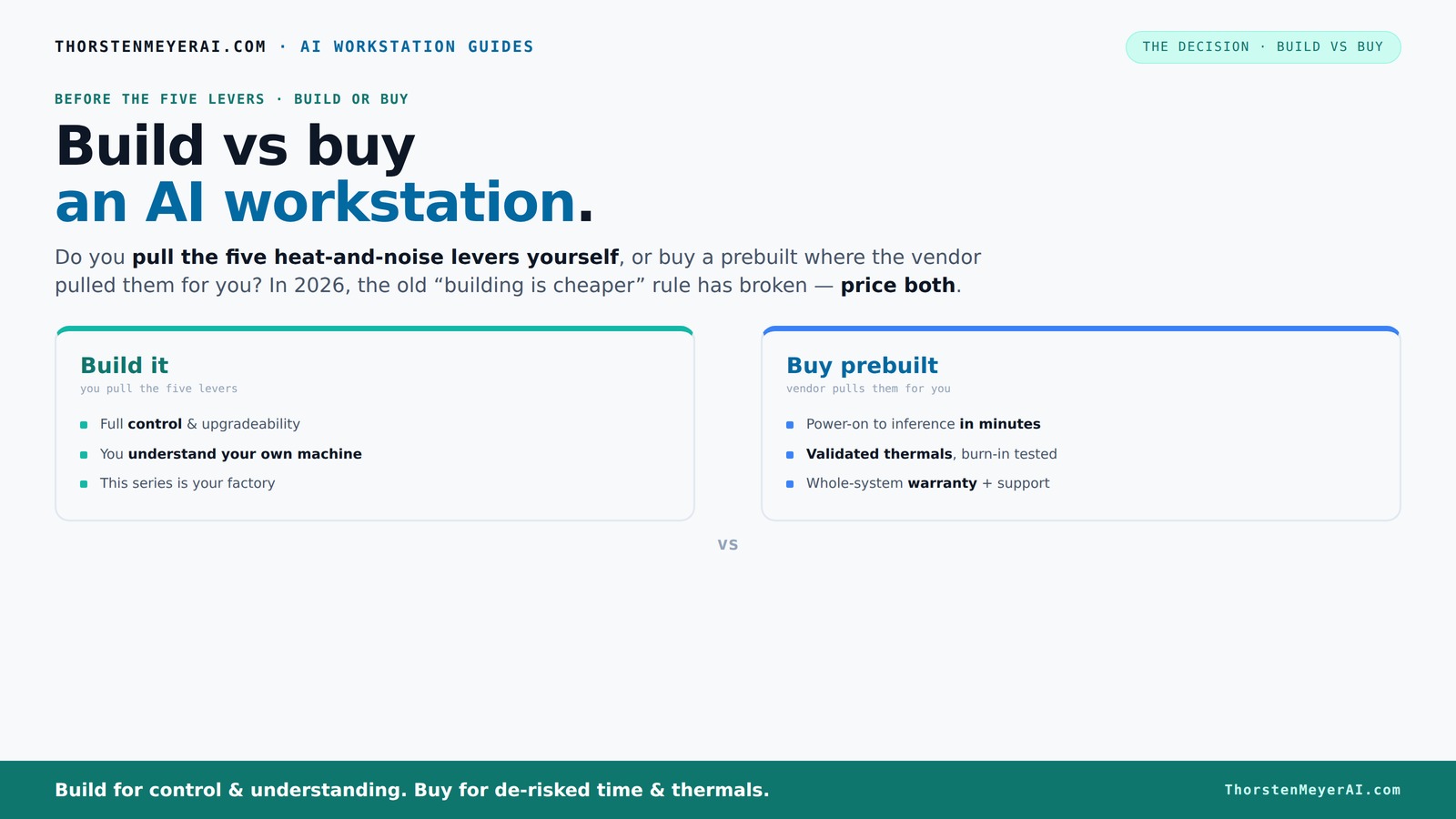
Build vs buy
an AI workstation.
The real question behind this whole series: do you pull the five heat-and-noise levers yourself, or buy a prebuilt where the vendor pulled them for you? And in 2026, the old “building is cheaper” rule has broken. Match your situation in Part 3.
Key Takeaways
- Component shortages in 2026 mean prebuilt systems often match or beat DIY prices for high-end AI workstations.
- Time-to-deployment favors prebuilt options, with many systems ready in 30–60 days versus months for DIY.
- Thermal management is critical; prebuilt vendors validate and tune for quiet, reliable operation under load.
- DIY builds offer unmatched customization but require expertise, time, and patience.
- Hybrid solutions are increasingly popular, blending speed and control for tailored performance.

WIWB Gaming PC Desktop Core I9-14900HX, RTX 5060 Ti 8G, 1TB NVME SSD
- Powerful Processor: Intel Core i9-14900HX with 24 Cores
- High-Performance Graphics: GeForce RTX 5060 Ti 8GB GDDR7
- Fast Memory & Storage: 16GB DDR5 RAM with 1TB NVMe SSD
As an affiliate, we earn on qualifying purchases.
As an affiliate, we earn on qualifying purchases.
Why 2026 Changes Everything About Building vs Buying
Component shortages and price spikes have hit DIY builders hard. A GPU that used to cost under $1,000 now often exceeds $1,250. DDR5 RAM and SSDs are no longer bargains either. Meanwhile, prebuilt vendors bought in bulk before prices surged, allowing them to offer systems at or below DIY prices.
For example, a top-tier GPU like the NVIDIA RTX 4090 was around $1,600 in 2025 but now can be found for $1,200–$1,400 in prebuilt systems. That flips the typical build-vs-buy script — where building was always cheaper, now it’s not always true.
According to HP, component shortages have extended lead times and increased costs, making the traditional DIY advantage less clear.

ASUS NUC 15 Pro Mini Desktop Computer, Intel Series 2 Core Ultra 7 255H, 32GB DDR5 RAM, 1TB PCIe SSD, Intel Arc 140T GPU, AI Mini PC Win 11 Pro, 8K/Quad 4K HDR, Thunderbolt 4, WiFi 7, BT 5.4
- Powerful AI & Multitasking: Intel Core Ultra 7 255H, 18% faster
- High-Performance Graphics: Intel Arc 140T GPU for AI and gaming
- Customizable Memory & Storage: Supports up to 128GB RAM, 48TB SSD
As an affiliate, we earn on qualifying purchases.
As an affiliate, we earn on qualifying purchases.
The Heat and Noise: Building or Buying, Who Handles the Levers?
Controlling heat and noise in a high-power AI workstation is a balancing act. For tips on cooling solutions, see building vs buying AI workstations. It’s like tuning a race car — you tweak voltage, airflow, and cooling to keep everything running smoothly. When you buy a prebuilt, the vendor has already pulled these levers — optimized cooling, tested thermal performance, and tuned fan curves.
For example, a vendor like Lambda tests their multi-GPU systems under load for 48 hours before shipping, ensuring they won’t throttle or overheat. They use water-cooling solutions that reduce noise by up to 30%. If you build your own, you become the engineer — choosing quiet GPUs, undervolting, and designing airflow yourself.
So, the question: do you want to pull the levers or pay someone else to do it? The choice impacts noise levels, thermal longevity, and your time investment.
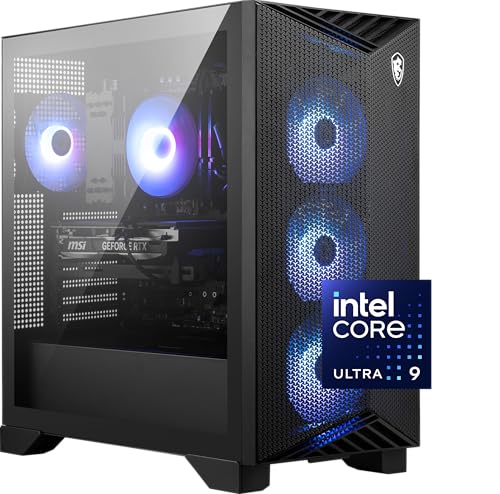
msi Aegis R2 AI Gaming Desktop: Intel Core Ultra 9 285, Geforce RTX 5070Ti, 32GB DDR5, 2TB M.2 NVMe SSD, Air Cooling, USB Type C, VR-Ready, Window 11 Home: C2NVR9-1452US
- Processor: Intel Core Ultra 9 285
- Design: Sleek, simple design
- Operating System: Windows 11 Home
As an affiliate, we earn on qualifying purchases.
As an affiliate, we earn on qualifying purchases.
Which Saves You More Time? Prebuilt or DIY?
Time is often the deciding factor. For a detailed comparison, see build vs buy a prebuilt AI workstation. Building a custom AI workstation can take anywhere from 3 to 6 months — sourcing parts, assembling, BIOS tuning, troubleshooting. Learn more about the process at build vs buy a prebuilt AI workstation. This lengthy process is driven by the complexity of selecting compatible components, dealing with potential shortages, and iterative troubleshooting. For many, this means extended delays that can stall project timelines, especially if urgent results are needed. The detailed process of tuning BIOS settings, testing stability, and optimizing thermal solutions can also require significant expertise and patience, adding to the overall time investment.
Buying a prebuilt cuts that down dramatically. Many vendors can deliver within 30 to 60 days, often with everything preinstalled — CUDA, PyTorch, TensorFlow, Docker. It’s a plug-and-play solution that gets you training models in days, not months. This rapid deployment is crucial when time-to-market matters or when your team needs immediate access to high-performance hardware without the steep learning curve of custom assembly and tuning.
For example, a professional AI team can deploy a prebuilt system and start inference in under two weeks, freeing up resources for actual work. That speed can be worth the premium, especially when project deadlines are tight or when hardware expertise is limited within the team.

NVD RTX PRO 6000 Blackwell Professional Workstation Edition Graphics Card for AI, Design, Simulation, Engineering - 96GB DDR7 ECC Memory - 4th Gen RT/5th Gen Tensor Core GPU - OEM Packaging
- Enhanced Processing Power: NVIDIA Blackwell Streaming Multiprocessor with neural shaders
- Advanced Cooling Design: Double-flow-through cooling for peak performance
- High-Performance Tensor Cores: 5th Gen Tensor Cores for AI acceleration
As an affiliate, we earn on qualifying purchases.
As an affiliate, we earn on qualifying purchases.
Cost Comparison: Building vs Buying — The Real Numbers
| Factor | Build |
|---|---|
| Component Cost | $1,250–$1,600+ (GPU, CPU, RAM, SSD, cooling) |
| Labor & Time | 3–6 months of your time, plus troubleshooting |
| Thermal Tuning & Testing | All manual, requires expertise |
| Warranty & Support | Limited, DIY-specific |
| Overall Cost Over 3 Years | Higher if maintenance, upgrades, and troubleshooting are factored in |
| Factor | Buy |
|---|---|
| Component Cost | $1,200–$1,500 (often including OS and software) |
| Time to Deploy | 30–60 days from order to setup |
| Thermal & Noise Optimization | Factory-tuned, validated, often quieter |
| Warranty & Support | Extended, with support and service plans |
| Overall Cost Over 3 Years | Often lower due to less maintenance and fewer troubleshooting costs |
When Does Building Make Sense?
Building your own makes sense if you need absolute control over every part — like a custom cooling system, specialized hardware, or a unique workflow. Hobbyists or students often prefer building because it’s a learning experience and can be cheaper if you already own tools and space.
For example, if you want a machine tuned specifically for quiet inference, you can choose a [quiet GPU](https://thorstenmeyerai.com/quiet-gpus-local-ai/) and design airflow that fits your room perfectly. However, this approach requires a significant investment in time, technical skill, and troubleshooting effort. The tradeoff is that you gain a tailored system that precisely matches your needs, but at the cost of longer setup time and potential instability if not properly managed.
Plus, if your project involves highly sensitive data or custom hardware, owning every component can be a security advantage. Building also allows you to upgrade incrementally, swapping out parts as needed, which can be more cost-effective over the long term if your hardware needs evolve gradually.
When Does Buying a Prebuilt Make Your Life Easier?
If speed, reliability, and support top your list, a prebuilt wins hands down. For more insights, visit Wihok. Companies like Lambda or Puget test every system under load, ensuring they won’t throttle or overheat. They handle the thermal engineering, so you don’t have to. This validation process is critical because it reduces the risk of unexpected failures during intensive workloads, which can be costly and disruptive. Prebuilts also often come with warranties and support plans that cover hardware issues, minimizing downtime and troubleshooting efforts for your team.
For example, a professional AI team can order a prebuilt with multi-GPU support, and have it operational in less than two months — ready to run complex models without headaches. This approach is especially beneficial for organizations that lack in-house hardware expertise or need rapid deployment to meet project deadlines.
It’s ideal if you prefer to focus on AI development rather than hardware troubleshooting. The added support and validation mean you can trust that the system is designed for demanding workloads, reducing the risk of thermal throttling, hardware failures, or noise issues that could interrupt your work.
Hybrid Approach: The Best of Both Worlds?
More organizations now combine both strategies. Buy a solid prebuilt foundation, then customize or upgrade specific parts — like adding additional RAM or a second GPU. This way, you get speed and reliability but also tailored fit. This approach allows you to leverage the proven thermal and performance design of prebuilt systems while still maintaining some level of customization to meet evolving needs or preferences. It can be a cost-effective compromise, especially if you want to avoid the full complexity of a complete DIY build but still desire some control over hardware choices.
For example, you might buy a prebuilt system from [Mac Studio](https://thorstenmeyerai.com/mac-vs-gpu-tower-local-llm/) and swap in a quieter cooling system or specialized storage to match your workflow. This enables incremental improvements, reduces initial setup time, and minimizes risks associated with full DIY projects. It also provides a flexible pathway to upgrade hardware as your workload grows or changes, which is often more manageable than starting from scratch.
This hybrid method encourages adaptability, allowing organizations to optimize for performance, noise, or security without committing to a full custom build upfront.
Frequently Asked Questions
Should I build or buy an AI workstation for my small startup?
If speed and support matter more than customization, buying prebuilt is usually better. It gets you up and running faster with less hassle, letting you focus on your AI projects instead of hardware troubleshooting.
How much can I save building my own AI workstation in 2026?
While building used to be cheaper, component shortages and increased prices mean it often costs the same or more now. Additionally, the time and expertise required can translate into hidden costs, delays, and potential errors. When you factor in troubleshooting, thermal tuning, and future upgrades, the initial savings diminish significantly. In many cases, the operational costs and risks outweigh the benefits, making prebuilt systems a more practical choice for most users.
What hidden costs come with building my own AI rig?
Expect to spend extra on troubleshooting, thermal tuning, and potential upgrades. Maintenance, driver updates, and potential hardware failures can also add to the total cost over time. These hidden costs can accumulate, especially if you lack experience or encounter hardware incompatibilities, leading to delays and increased expenses. Recognizing these potential pitfalls is crucial when evaluating whether DIY is truly cost-effective or if the convenience and reliability of prebuilt systems justify the higher upfront price.
Can prebuilt workstations handle heavy AI training and inference?
Yes, vendors validate thermal performance and support high GPU counts, making their systems suitable for demanding AI workloads. Properly configured, these systems can sustain heavy training and inference tasks without overheating or throttling. However, always check the specific hardware specifications, cooling solutions, and support options to ensure the system meets your workload requirements. Well-designed prebuilt systems often include advanced cooling and power management features that are difficult to replicate in custom builds without significant expertise.
Is hybrid the best approach for most AI teams?
For many, yes. Buying a solid base system and customizing key components offers a good balance of speed, control, and cost. This approach allows organizations to benefit from the reliability of pre-engineered thermal and power solutions while still tailoring hardware to specific needs, such as adding more RAM or specialized storage. It also provides flexibility to upgrade incrementally as workloads evolve, reducing the need for complete rebuilds. However, it requires careful planning to ensure compatibility and optimal performance, making it suitable for teams with some technical expertise or access to support resources.
Conclusion
The choice between build and buy comes down to your priorities. If you crave speed, support, and a proven thermal design, prebuilt options are hard to beat in 2026. But if you love tinkering, want custom hardware, or have specific security needs, building your own still makes sense — just be prepared for a longer journey.
Remember, in the end, it’s about what aligns best with your goals and resources. Your perfect AI workstation is the one that gets you working fast, confidently, and on your terms.