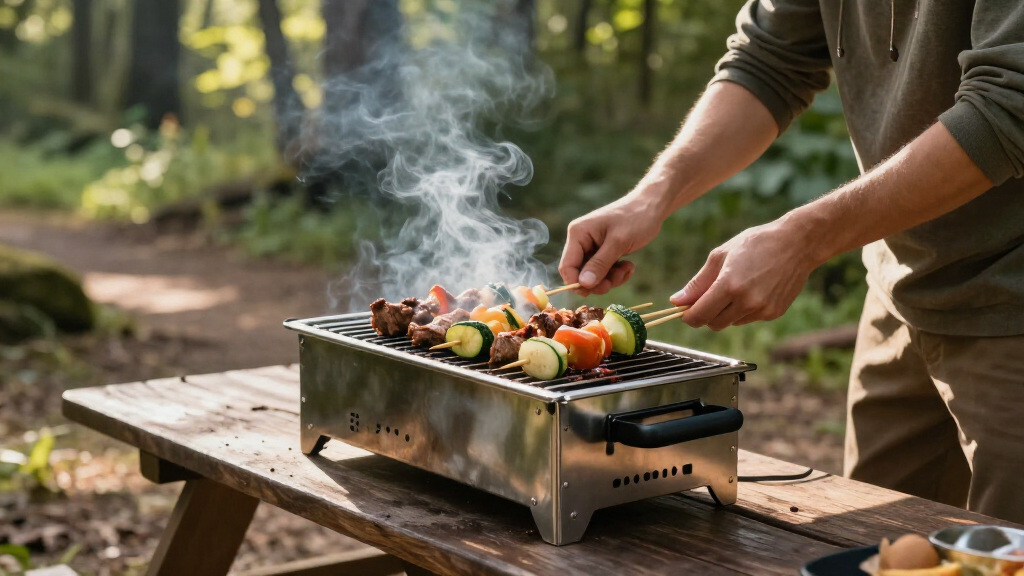
Portable outdoor grills split into three camps: charcoal models that deliver smoky flavor at the cost of setup time, gas grills that trade some taste for push-button convenience, and electric options for places with open-flame bans. After comparing 14 popular models, the Weber Jumbo Joe stands out as the best overall pick because its 18-inch cooking surface handles real meals for a group while still packing into a car trunk. For tighter budgets, the Gas One 14-inch charcoal grill delivers surprising performance under $40, and the Coleman RoadTrip 285 is the standout if you want a full stand-up grill with three burners that folds into a rolling cart. The main tradeoff you’ll face is cooking capacity versus weight — bigger grates mean better meals but heavier loads. Read on for the full breakdown of every model.
Complete the kit

![[Upgraded 1000D Heavy Duty Fabric] 60 inch Grill Cover fo...](https://m.media-amazon.com/images/I/81i7JfVukfL._AC_SL480_.jpg)

Key Takeaways
- The Weber Jumbo Joe’s 18-inch grate is the only compact charcoal option here that comfortably cooks for four or more people, which is why it takes the top spot despite a higher price than most charcoal competitors.
- BTU numbers were less predictive of cooking performance than grate size and lid design — the 5,500 BTU Cuisinart Petite Gourmet sears adequately for one or two people, while cheaper single-burner units with the same output struggled with heat retention.
- Four of the 14 models are nearly identical folding charcoal box grills (Charmline, Gas One, Joyfair, and the dual-sided griddle model), differing mainly in vents, thermometers, and accessories — buying on included extras, not brand, saves money here.
- The George Foreman electric is the only pick that works on balconies and in campgrounds with open-flame restrictions, making it the fallback choice rather than a performance pick.
- Only the Coleman RoadTrip 285 offers a true stand-up cooking experience with wheels, so anyone who hates hunching over a tabletop should expect to pay double the price of most portable models.


| portable outdoor grill | Fuel Type | Material | Dimensions |
|---|---|---|---|
| Royal Gourmet GT1001 Stainless | Propane | Stainless Steel | — |
| Charmline 14 x 9 Inch Small Po | Charcoal | Alloy steel | 14 x 9 inches |
| Gas One 14-Inch Portable Charc | Charcoal | — | — |
| Tabletop Charcoal Grill | Charcoal | Thickened painted iron | 16.1 x 9.8 x 12.2 inches |
| Weber Jumbo Joe Charcoal Grill | Charcoal | Porcelain-enameled steel | 19.75 x 20.5 x 19.75 inches |
| Cuisinart 14-Inch Portable Cha | Charcoal | Alloy steel, chrome-plated grate | 14 x 14 x 15 inches |
| Joyfair Portable Charcoal Gril | Charcoal | Powder-coated metal | 10 x 14 x 10 inches |
| George Foreman Indoor/Outdoor | — | — | — |
| Cuisinart Portable Gas Grill w | Propane gas | Enameled steel | 20.5 x 12 x 10.2 inches |
| Cuisinart Petite Gourmet Gas G | Propane gas | — | — |
| Cuisinart Portable Gas Grill | — | Stainless steel | — |
| Megamaster Tabletop 1 Burner G | Gas (propane) | — | — |
| Charbroil Portable Convective | — | — | 15" H x 24.1" W x 12.3" D |
| Coleman RoadTrip 285 Portable | — | — | — |
More Details on Our Top Picks
Royal Gourmet GT1001 Stainless Steel Portable Gas Grill, 10,000 BTU Tabletop
This option stands out for balancing real cooking power with genuine portability — the 10,000 BTU U-shaped burner heats faster and more evenly than the smaller Cuisinart 8,000 BTU portable, which matters when you’re feeding a hungry campsite. With 285 square inches of total cooking area (plus a warming rack), it out-cooks every charcoal model here, including the Weber Jumbo Joe, without the wait for coals to ash over. Compared with the Gas One 14-inch, cleanup is far less messy: a removable grease tray beats scraping ash by a wide margin. The tradeoff is that you’re tethered to a propane tank, and as a tabletop unit it still needs a stable surface — no built-in stand like the Coleman RoadTrip 285.
Pros:- 10,000 BTU U-shaped burner heats quickly and evenly
- 285 sq. in. of cooking space with warming rack handles group meals
- Folding legs and lockable lid make transport simple
- Removable grease tray keeps cleanup fast
Cons:- Requires a propane canister, adding weight and fuel logistics
- Tabletop only — no stand, so it’s not a full-size grill replacement
Best for: Tailgaters and campsite cooks who want push-button gas convenience and enough grate space for four to six people
Not ideal for: Backpackers and purists who want smoky charcoal flavor without hauling a propane canister
- BTU:10,000
- Cooking Area:285 sq. in.
- Grate Area:214 sq. in.
- Warming Rack:71 sq. in.
- Material:Stainless Steel
- Portability:Folding legs, lockable lid, carry handle
- Temperature Gauge:Yes
- Fuel Type:Propane
Our verdict“If you want one portable grill that does everything reasonably well with gas convenience, this is the safest all-around pick.”
Charmline 14 x 9 Inch Small Portable Charcoal BBQ Grill
This model makes the most sense for solo travelers and pairs who count every cubic inch. Folding down to a flat 14 x 9 x 3 inch slab, it packs into spaces the Royal Gourmet and Weber Jumbo Joe simply can’t — a pannier, a beach tote, a kayak hatch. The no-assembly setup also puts it ahead of the Jumbo Joe, which requires assembly before its first cook. Compared with the Gas One 14-inch, the smaller footprint means a sauce shelf instead of an ash catcher, so you trade cleanup convenience for packability. The obvious limit is capacity: this is a 1–3 person grill, full stop. Anyone cooking for a group will find it frustrating, and the thin alloy steel demands patient charcoal management to avoid warping over time.
Pros:- Folds flat to 3 inches thick for minimal packed volume
- Zero assembly — ready to cook in minutes
- Dedicated sauce/prep shelf is a smart small-grill touch
- Alloy steel construction holds up to regular light use
Cons:- Strictly limited to 1–3 people
- No ash management system, so cleaning is manual
Best for: Solo campers, cyclists, and couples who prioritize packed size over cooking capacity
Not ideal for: Families or group cooks — the 14 x 9 inch grate maxes out at about three burgers
- Dimensions:14 x 9 inches
- Folded Size:14 x 9 x 3 inches
- Material:Alloy steel
- Capacity:1–3 people
- Assembly:None required
- Fuel Type:Charcoal
- Color:Green
Our verdict“The right choice when packed size matters more than cooking capacity — skip it if you ever feed more than three.”
Gas One 14-Inch Portable Charcoal Grill with Locking Lid and Dual Venting
For the price of a pizza night, this grill delivers the two features that actually matter in cheap charcoal cookers: heat control and ash management. The dual venting system gives you real temperature influence, something the Charmline lacks entirely, while the ash catcher spares you the messy dump-out routine smaller grills demand. The 3-point locking lid is a genuinely useful touch — you can carry it with hot coals inside, which the Weber Jumbo Joe also does but at more than double the price. Compared with the Jumbo Joe, you give up cooking area (150 vs. 240 square inches) and long-term build quality, so the savings come with a shorter expected lifespan. Expect a basic, utilitarian design rather than anything you’ll show off at the tailgate.
Pros:- Dual vents allow genuine temperature control
- Ash catcher keeps the mess contained
- Locking lid makes transport with coals safer
- Very low price for the feature set
Cons:- 150 sq. in. grate limits you to small batches
- Build quality is basic and not built for years of heavy use
Best for: First-time charcoal grillers and occasional campers who want vent control and easy cleanup without spending much
Not ideal for: Frequent grillers who cook weekly — the thinner construction and smaller grate will feel limiting fast
- Cooking Surface:150 sq. in.
- Diameter:14 inches
- Lid:3-point locking system
- Ventilation:Dual venting system
- Ash Catcher:Yes
- Fuel Type:Charcoal
- Portability:Lightweight and compact
Our verdict“The cheapest way into charcoal grilling without sacrificing vents or an ash catcher — a smart starter, not a lifelong tool.”
Tabletop Charcoal Grill, Portable Foldable BBQ with Dual Sided Griddle & Grill
The flip-style dual cooking surface is what separates this one from everything else in the lineup: one side sears burgers and dogs over charcoal, the other works as a griddle for eggs, bacon, and stir-fry — capability no other pick here matches, including the gas-powered Royal Gourmet. That makes it the obvious choice for breakfast-and-dinner camping trips where one device needs to do both jobs. At 8.3 pounds, it’s heavier than the Charmline despite a similar mission, so it belongs in the car rather than the backpack. The thickened steel resists warping better than budget foldables, but the painted-iron finish will show wear faster than the Weber Jumbo Joe’s porcelain enamel, and there’s no lid at all — no heat retention, no wind protection, no smoking.
Pros:- Reversible grill/griddle doubles your menu options
- Thickened steel resists warping under high heat
- Folds flat for car camping and picnic transport
- At 8.3 lbs it’s still manageable for short carries
Cons:- No lid means no heat retention or wind protection
- Painted iron finish is less durable than porcelain enamel
Best for: Camp cooks who want grill AND griddle capability in one packable device, especially for full-day outings
Not ideal for: Anyone who needs a lid for roasting, smoking, or windy-weather cooking — there isn’t one
- Dimensions:16.1 x 9.8 x 12.2 inches
- Weight:8.3 lbs
- Material:Thickened painted iron
- Fuel Type:Charcoal
- Cooking Surfaces:Dual-sided (grill and griddle)
- Capacity:2–6 people
- Design:Foldable tabletop
Our verdict“Buy it for the griddle flexibility; skip it if closed-lid cooking matters to you.”
Weber Jumbo Joe Charcoal Grill, 18-Inch
This is the buy-it-once option in the portable charcoal field. The porcelain-enameled bowl and lid shrug off rust and heat cycles that would warp the Gas One or Charmline within a couple of seasons, and the rust-resistant aluminum dampers give precise low-and-slow control that cheaper grills can’t hold. At 240 square inches, it nearly matches the Royal Gourmet’s grate area while delivering the charcoal flavor gas can’t replicate. The premium comes at a real cost: it’s the most expensive charcoal pick here, it requires assembly (the Charmline needs none), and despite being called portable, its 19.75-inch footprint is closer to a compact backyard kettle than a backpacking tool. Compared with the foldable options, you’re choosing longevity over packability.
Pros:- Porcelain-enameled construction built to last many seasons
- 240 sq. in. grate rivals larger portable gas grills
- Aluminum dampers enable precise temperature control
- Ash catcher simplifies post-cook cleanup
Cons:- Highest price among the charcoal picks
- Requires assembly and doesn’t fold for storage
Best for: Grillers who want Weber-grade durability and charcoal flavor for car camping, balconies, and small patios
Not ideal for: Space-constrained travelers — it doesn’t fold, so it eats cargo room compared with flat-packing rivals
- Cooking Area:240 sq. in.
- Diameter:18.5 inches
- Dimensions:19.75 x 20.5 x 19.75 inches
- Material:Porcelain-enameled steel
- Handle:Glass-reinforced nylon
- Damper Material:Rust-resistant aluminum
- Ash Catcher:Yes
- Fuel Type:Charcoal
Our verdict“The pick if you’d rather pay once for a grill that outlives the cheaper options — just make sure you have room to haul it.”
Cuisinart 14-Inch Portable Charcoal Grill
For buyers who want real charcoal flavor at a rock-bottom price, this little Cuisinart is the easiest entry point in the lineup. Its 196 sq. in. of cooking space actually edges out the Joyfair charcoal grill’s 118.8 sq. in., yet it folds into a briefcase-style package with three secure lid locks that make carrying it to a campsite nearly effortless. Compared with the Weber Jumbo Joe, you give up cooking depth and heat retention, but you also give up most of the price. The dual adjustable vents genuinely matter at this size — they’re the difference between searing a burger and steaming it. Just know the limitations: this is a grill for two to three people, not a tailgate crew, and it demands charcoal patience rather than gas convenience.
Pros:- Ultra-affordable charcoal option with genuine smoky flavor
- Folds into a locked, briefcase-style package for easy carrying
- Dual vents give surprising temperature control for the price
- Enamel-coated firebox and ash catcher simplify cleanup
Cons:- Small cooking area limits batch cooking
- Nowhere near the heat retention or capacity of the Weber Jumbo Joe
- Listed weight is inconsistent between sources (2 lbs vs 4 lbs)
Best for: Budget-conscious campers and couples who want authentic charcoal flavor without spending much
Not ideal for: Families or tailgaters cooking for five or more — the 196 sq. in. surface can’t keep up
- Cooking Surface Area:196 sq. in.
- Fuel Type:Charcoal
- Dimensions:14 x 14 x 15 inches
- Weight:2 lbs (listed)
- Material:Alloy steel, chrome-plated grate
- Special Features:Dual vents, 3 lid locks, ash catcher
Our verdict“This is the cheapest way to get true charcoal grilling on the go, as long as you’re only feeding two or three people.”
Joyfair Portable Charcoal Grill with Thermometer
What separates the Joyfair from the Cuisinart 14-inch is the built-in lid thermometer — a rare feature in this price bracket that lets you cook to a target temperature rather than guessing. For anyone who’s ever ruined chicken over unpredictable coals, that dial changes behavior: you can hold a steady roast instead of chasing hot spots. Its powder-coated steel body and triangular base feel sturdier on uneven campsite ground than boxier folding grills like the Charmline, which is essentially a disposable-style folding tray. The tradeoff is cooking area — at 118.8 sq. in., it’s the smallest charcoal surface here, and with no adjustable vents you control heat only by coal arrangement. At 8 lbs it’s also heavier than the Cuisinart, so it belongs in a car trunk rather than a backpack.
Pros:- Built-in lid thermometer for guided, even cooking
- Stable triangular structure handles uneven ground well
- Rust-resistant powder coating survives outdoor storage
- Tool-free assembly in minutes
Cons:- Only 118.8 sq. in. of cooking space
- No adjustable vents — heat control depends entirely on coal management
- Heavier than comparable compact charcoal grills
Best for: Campers who want charcoal flavor with predictable, thermometer-guided cooking for 2–3 people
Not ideal for: Backpackers or anyone cooking for a group — it’s the heaviest and smallest charcoal option in this batch
- Cooking Surface Area:118.8 sq. in.
- Fuel Type:Charcoal
- Dimensions:10 x 14 x 10 inches
- Weight:3.61 kg (approx. 8 lbs)
- Material:Powder-coated metal
- Special Feature:Built-in lid thermometer
Our verdict“Buy it for the thermometer and stability; skip it if you need capacity or vent-based heat control.”
George Foreman Indoor/Outdoor Electric Grill with Stand, 15-Serving
This is the only grill in the entire roundup that solves a specific problem: flame bans. If your apartment balcony, condo patio, or campground prohibits propane and charcoal, the George Foreman is legally your only option here — the gas and charcoal models simply can’t go where you can. The removable stand means it works as a tabletop indoor grill in winter and a freestanding patio unit in summer, and the 15-serving capacity comfortably out-cooks the Cuisinart Portable Gas Grill’s 146 sq. in. surface. The sloped, nonstick design is the real draw for health-conscious buyers — up to 42% fat reduction — but that slope demands a perfectly level setup to drain properly. And unlike the Coleman RoadTrip 285, there’s no flame, no smoke flavor, and no searing power: this is convenience grilling, not craft grilling.
Pros:- Only option here that works under propane and charcoal bans
- Removable stand switches between tabletop and freestanding use
- 15-serving capacity beats most compact grills in this lineup
- Nonstick sloped surface removes up to 42% of fat and wipes clean
Cons:- Requires perfectly level positioning for the fat-drainage slope to work
- No open flame means no sear, smoke flavor, or high-heat crust
- Tethered to an outlet — genuinely portable only near power
Best for: Apartment and condo dwellers with no-flame rules who still want outdoor-adjacent grilling
Not ideal for: Flavor purists — electric heat produces no sear or smoke character compared with charcoal or gas
- Power Source:Electric
- Servings:15
- Temperature Settings:5
- Fat Removal:Up to 42%
- Stand:Removable
- Cooking Surface:George Tough nonstick coating
Our verdict“If open flames are banned where you live, this is your grill; if flavor is your priority, choose gas or charcoal instead.”
Cuisinart Portable Gas Grill with Locking Lid, 8,000 BTU
Of the three gas grills in this batch, this Cuisinart hits the sweet spot between price, power, and packability. Its 8,000 BTU burner pushes past 600°F — real searing territory the 5,500 BTU Petite Gourmet can’t reach — while staying 3 lbs lighter and far cheaper than the Coleman RoadTrip 285. The tool-free setup and dishwasher-safe grates mean you’re cooking within five minutes of arriving at a campsite, which no charcoal model here can claim. Compared with the Royal Gourmet GT1001’s 10,000 BTU output, you sacrifice a bit of punch, but you gain a tighter, more car-friendly footprint. The honest downsides: a single burner with no adjustable heat levels limits zone cooking, and 146 sq. in. means grilling in shifts for any group beyond four.
Pros:- Reaches over 600°F for genuine searing
- Tool-free setup and dishwasher-safe parts speed up camp cooking
- Locking lid and 10-lb weight make it effortless to transport
- Better value per BTU than larger portable gas grills
Cons:- Single burner with no adjustable heat levels
- 146 sq. in. of surface constrains group cooking
- Less raw power than the Royal Gourmet GT1001 or Coleman RoadTrip 285
Best for: Tailgaters and campers who want push-button gas grilling and real searing heat on a budget
Not ideal for: Cooking for crowds — one burner and 146 sq. in. force you to grill in multiple rounds
- Cooking Surface Area:146 sq. in.
- BTU:8,000
- Fuel Type:Propane gas
- Weight:10 lbs
- Dimensions:20.5 x 12 x 10.2 inches
- Material:Enameled steel
Our verdict“The smartest gas pick for solo grillers and pairs who prioritize speed and sear over capacity.”
Cuisinart Petite Gourmet Gas Grill with VersaStand
The Petite Gourmet’s party trick is the integrated telescoping VersaStand — the only grill in this batch that converts from tabletop to full freestanding mode without buying or carrying anything extra. That matters if you grill at campsites without picnic tables, where the Cuisinart 8,000 BTU model and Royal Gourmet GT1001 leave you crouching or hauling a separate surface. Its porcelain-enameled grate cleans up in the dishwasher, and the fold-flat profile slips into a trunk alongside coolers and gear. The catch is heat: at 5,500 BTU, it runs noticeably cooler than the 8,000 BTU Cuisinart, so thick steaks and bone-in chicken take longer and lose crust. Think of it as the convenience-first gas pick — stand, table, or tailgate — rather than the performance pick.
Pros:- Built-in telescoping stand converts tabletop to freestanding instantly
- Folds flat for compact transport
- Dishwasher-safe porcelain-enameled grate
- 150 sq. in. of cooking space handles family-size meals
Cons:- 5,500 BTU output lags behind comparable portable gas grills
- Not built for heavy-duty or high-volume grilling
- Requires propane canisters, adding a recurring cost and packing item
Best for: Campers and picnickers who need a grill that stands on its own where no table exists
Not ideal for: Sear-focused grillers — 5,500 BTU can’t match the heat output of the 8,000 BTU Cuisinart
- Cooking Area:150 sq. in.
- BTU:5,500
- Fuel Type:Propane gas
- Dimensions (folded):22.5″ x 17.5″ x 9.75″
- Grate Material:Porcelain-enameled
- Special Feature:Integrated telescoping VersaStand
Our verdict“Choose this for its do-everywhere stand and fold-flat portability, not for raw grilling power.”
Cuisinart Portable Gas Grill, 20,000 BTU, 2-Burner
This model earns the top spot because it strikes the best balance between cooking power and genuine portability in the entire gas category here. With 20,000 BTUs across two burners, it matches the Coleman RoadTrip 285 in raw heat while packing it into a lighter, 22-pound body that’s easier to carry to a campsite. The two-burner layout is what separates it from single-burner options like the Megamaster Tabletop — being able to run a hot zone and a cooler zone at the same time means burgers and buns finish together instead of in shifts. Stainless steel grates and a locking lid round out a package that feels complete rather than stripped down.
The tradeoffs are real, though. Two burners still cap capacity compared with a full-size grill, and there are no side shelves for prep space, which the Coleman partly solves with its stand-up design. Propane refills also become a recurring cost if this grill sees weekly use.
Pros:- Two burners enable true two-zone cooking, rare at this size
- 20,000 BTUs matches larger portable grills at only 22 lb.
- Tool-free setup in under 10 minutes
- Stainless steel grates distribute heat evenly and resist rust
Cons:- No side shelves or prep surfaces
- Propane cylinders need frequent refilling with regular use
- Cooking area is modest for gatherings over six people
Best for: Couples and small families who want real two-zone grilling capability at a campsite or tailgate without hauling a full-size grill
Not ideal for: Large groups hosting big cookouts — two burners and a compact grate won’t keep pace with crowds, and buyers wanting prep shelves should look elsewhere
- BTU:20,000
- Burners:2 stainless steel
- Weight:22 lb.
- Material:Stainless steel
- Grates:Stainless steel
- Lid:Locking lid
- Setup:Tool-free, under 10 minutes
Our verdict“If you want one portable grill that does almost everything well — power, control, and travel-friendliness — this is the pick that justifies its top ranking.”
Megamaster Tabletop 1 Burner Gas Grill with Foldable Legs and Warming Rack
What makes this option stand out is its 360 sq in of cooking area — the largest grilling surface of any portable model in this lineup, including the physically bigger Coleman RoadTrip 285 with its 285 sq in. For buyers whose priority is feeding several people from a single tabletop unit, that extra real estate matters more than raw specs. The single 11,000 BTU burner heats quickly and the built-in thermometer helps hold a steady temperature, while foldable legs and a locking lid make it as travel-friendly as the smaller Royal Gourmet GT1001.
The compromises come from that single-burner layout: everything on the grate cooks at the same intensity, so you lose the two-zone flexibility the Cuisinart 2-Burner provides. And the foldable legs, while convenient, are the component most likely to loosen after a season of loading in and out of a trunk — a durability question the sturdier fixed-leg designs avoid.
Pros:- 360 sq in cooking area is the largest among these portables
- Warming rack keeps finished food hot while the rest cooks
- Foldable legs and locking lid simplify transport
- Quick 11,000 BTU heating with built-in thermometer
Cons:- Single burner prevents two-zone cooking
- Foldable legs may develop wobble with heavy use
- No side shelves or storage for tools and plates
Best for: Tailgaters and campsite cooks who want maximum burger capacity from a tabletop grill that fits in a car trunk
Not ideal for: Buyers who cook mixed menus — one burner means no indirect heat, so chicken thighs and delicate vegetables can’t share the grate
- Fuel Type:Gas (propane)
- Heating Power:11,000 BTUs
- Main Burner Count:1
- Cooking Space:360 sq in
- Warming Rack:Yes
- Foldable Legs:Yes
- Thermometer:Built-in
Our verdict“This is the pick when cooking capacity matters more than burner flexibility — nobody else in this lineup fits this much grate into a tabletop footprint.”
Charbroil Portable Convective 1-Burner Propane Gas Grill
This is the entry point of the gas lineup — a simple, no-frills single-burner that costs less than the Cuisinart 2-Burner or the Coleman RoadTrip 285 and asks very little in return. The porcelain-coated grates are its best feature at this price: they resist rust and wipe clean in minutes, which matters if the grill lives in a garage or gets tossed in a camper between trips. Assembly is straightforward, and its 24-inch width still gives two people room to cook without the cramped feel of smaller charcoal units like the Charmline 14-inch.
Where the low price shows is in the details. There’s no thermometer, no warming rack, and no advanced heat control — the Megamaster includes all three for a modest step up in cost. The 90-day warranty is also the shortest in this roundup, so buyers are effectively betting on build quality with a thin safety net. This model makes the most sense as an occasional-use grill, not a weekly workhorse.
Pros:- Lowest-cost propane option in the lineup
- Porcelain-coated grates resist rust and clean easily
- Simple assembly and intuitive operation for beginners
Cons:- Only 90-day warranty, the shortest here
- No thermometer, warming rack, or advanced controls
- Single burner with just 190 sq in of cooking space
Best for: First-time grillers or occasional campers who want a cheap, dependable propane option for a handful of trips per year
Not ideal for: Frequent cooks and anyone who wants temperature precision — the basic controls and missing thermometer make consistent results harder
- Cooking System:Liquid propane, convective
- Burners:1
- Cooking Area:190 sq in
- Grates:Porcelain-coated
- Dimensions:15″ H x 24.1″ W x 12.3″ D
- Finish:High-temperature, rust-resistant steel
- Warranty:90 days
Our verdict“A sensible budget buy for sporadic outdoor cooking, as long as you accept bare-bones features and a short warranty.”
Coleman RoadTrip 285 Portable Stand-Up Propane Grill with 3 Adjustable Burners and Instastart Ignition
This is the most capable grill in the batch, and the one designed for people who cook outdoors often enough to justify it. Three independently adjustable burners put it a step above the Cuisinart 2-Burner in control — you can sear steak over one burner while gently warming rolls over another, a level of zoning no other portable here offers. The stand-up design with wheels and quick-fold legs eliminates the tabletop requirement entirely, which is a genuine advantage at tailgates where picnic space is scarce, and the Instastart ignition plus a three-year warranty signal a build quality the budget Charbroil can’t match.
The catch is portability in the literal sense. Compared with the 22-pound Cuisinart or the leg-folding Megamaster, this model is bulkier and heavier to lift — the wheels help on pavement but not on sand or gravel. Propane cylinders are also sold separately, adding to the true cost of ownership.
Pros:- Three adjustable burners allow precise multi-zone cooking
- Stand-up design with wheels means no table needed
- Instastart push-button ignition and integrated thermometer
- 3-year warranty, far beyond most portables here
Cons:- Larger and heavier than tabletop rivals, limiting true portability
- Propane cylinders sold separately
- Higher price point than single- and dual-burner alternatives
Best for: Regular tailgaters and camp hosts who want full-size grilling control — three heat zones and a stand — in a grill that travels by car
Not ideal for: Backpack campers and anyone with limited trunk space — despite the wheels, this is the least compact option in the lineup
- BTU:20,000
- Burners:3, independently adjustable
- Grilling Area:285 sq in
- Ignition:Instastart push-button
- Thermometer:Integrated
- Stand:Quick-fold legs with wheels
- Warranty:3 years
Our verdict“For frequent outdoor cooks who want the most control and convenience money can buy in a portable format, this stand-up grill is worth the premium and the extra cargo space.”
How We Picked
I evaluated these 14 grills through the lens of what actually matters when cooking away from home: packed size and weight, heat control, cooking capacity, cleanup effort, and price relative to what you get. A grill that sears beautifully but takes twenty minutes to cool, empty, and repack fails the portability test, so assembly and ash or grease management carried real weight in the rankings. For gas models, I compared BTU output against grate area, because high BTUs on a tiny surface just means burned burgers.
The ranking logic favors versatility-per-dollar and build durability. The Weber Jumbo Joe leads because its porcelain-enameled body and full-size grate outlast cheaper folding boxes that warp after a season. Value picks went to models that keep the essentials (decent vents, stable legs, secure latches) without padding the price with gadgets. Premium placement went to the Coleman RoadTrip 285 for bringing a genuine three-burner kitchen into a rolling format, and beginner-friendly spots went to gas and electric models with push-button starts and minimal temperature management.
| portable outdoor grill | Fuel Type |
|---|---|
| Royal Gourmet GT1001 Stainless | Propane |
| Charmline 14 x 9 Inch Small Po | Charcoal |
| Gas One 14-Inch Portable Charc | Charcoal |
| Tabletop Charcoal Grill | Charcoal |
| Weber Jumbo Joe Charcoal Grill | Charcoal |
| Cuisinart 14-Inch Portable Cha | Charcoal |
| Joyfair Portable Charcoal Gril | Charcoal |
| George Foreman Indoor/Outdoor | — |
| Cuisinart Portable Gas Grill w | Propane gas |
| Cuisinart Petite Gourmet Gas G | Propane gas |
| Cuisinart Portable Gas Grill | — |
| Megamaster Tabletop 1 Burner G | Gas (propane) |
| Charbroil Portable Convective | — |
| Coleman RoadTrip 285 Portable | — |
Factors to Consider When Choosing Portable Outdoor Grills
Before locking in a pick, step back and think about how you actually cook outdoors. The right portable grill depends less on specs and more on your typical trip length, group size, and where you’re allowed to use open flames.Fuel Type: The Decision That Shapes Everything Else
Charcoal, propane, and electric each change the entire experience, not just the flavor. Charcoal delivers the best smoky results and the cheapest fuel per cook, but it demands 20–30 minutes of prep time and a safe way to dispose of hot ash — a real problem at campsites with strict rules. Propane lights instantly and gives precise heat control, but you’ll need to buy and transport disposable 1-pound canisters, which cost more per hour of cooking and create waste. Electric solves the flame-ban problem on balconies and in dry-season campgrounds, but it caps your searing power and ties you to an outlet. A common mistake is buying charcoal for the flavor and then discovering you don’t have the patience for it after a long hike — be honest about your cooking style before choosing.
Cooking Surface Area: Bigger Than You Think You Need
Manufacturers list grate diameter, but what matters is usable cooking area after accounting for indirect zones. A 14-inch grate fits about four burgers with zero room to move them away from flare-ups, while an 18-inch surface lets you park meat on the cool side and finish vegetables on the hot side. My advice: add one person to your typical group size when calculating capacity. If you usually cook for three, buy a grill rated for four, because crowded grates produce steamed, gray food instead of seared food. Also check whether the grate is removable — fixed grates make scraping ash and grease dramatically harder.
Weight and Packed Form Factor
There’s a hard line between a grill you carry 50 feet from the car and one you carry a mile to a campsite. Anything over 20 pounds stops feeling portable quickly, especially with fuel and food packed alongside it. Tabletop models under 15 pounds shine for tailgating and car camping, while folding charcoal boxes under 5 pounds suit hikers and kayak trips. Watch for how the grill packs, too — models with legs that fold flat or detach save serious trunk space, and a locking lid that clamps the grate inside means you can pack up while the grill is still warm without loose parts rattling around. If you have back or knee issues, a stand-up model with wheels beats any tabletop option regardless of weight.
Heat Control and Venting Quality
Portable grills live or die on their ability to hold steady temperatures in wind and cold. On charcoal models, dual vents (top and bottom) are non-negotiable — single-vent designs choke the fire and give you a narrow, unpredictable heat range. On gas models, look at valve granularity, not just BTU count: a burner that only runs full-blast or off is useless for anything beyond hot dogs. Lid fit matters more than most buyers realize; loose-fitting lids leak heat in breezy conditions and can double your cooking time. If you plan to grill anything beyond burgers — chicken thighs, thicker steaks, roasting vegetables — temperature range should outweigh raw power in your decision.
Build Quality and Long-Term Cost of Ownership
The cheapest grills in this roundup cost under $30, but many use thin steel that warps, rusts at the hinges, or sheds coating into your food within a season or two. Porcelain-enameled bodies and stainless grates cost more upfront but survive years of transport abuse. Factor in consumables, too: charcoal models need ash trays or disposable liners, gas models need canisters running $5–8 each, and electric models add pennies to your power bill but need a compatible outlet. A realistic rule — if you grill more than twice a month, spending an extra $30–50 on durable construction pays for itself within two seasons in replacement savings. Check replacement parts availability as well, since grates and burner tubes are the first things to fail.
Frequently Asked Questions
Is charcoal or gas better for a portable grill?
It comes down to your patience and cooking habits. Charcoal wins on flavor and fuel cost — a $12 bag of briquettes covers many cooks — but demands 20–30 minutes of lighting time and careful ash disposal. Gas wins on convenience, lighting with one click and heating in five minutes, which matters enormously on weeknight tailgates or quick camping breakfasts. Gas also gives finer temperature control for delicate items like fish. If you cook mostly burgers and dogs and enjoy the ritual, go charcoal; if you grill varied foods on tight schedules, gas will get used far more often, and a grill that gets used beats a theoretically better one that stays in the garage.
How many BTUs do I actually need in a portable gas grill?
Ignore the raw BTU arms race and think in BTUs per square inch of grate — roughly 80–100 per square inch is the sweet spot for searing. The 5,500 BTU Cuisinart Petite Gourmet performs adequately on its small grate, while a 10,000 BTU burner spread across an oversized surface can feel weak. Anything in the 8,000–12,000 BTU range handles burgers, chicken, and vegetables for two to four people. The 20,000 BTU two-burner models and the three-burner Coleman RoadTrip 285 are only necessary if you’re cooking for groups of six or more, or you want independent zones for simultaneous direct and indirect cooking. More power also burns through propane canisters faster, so overbuying costs you at the store and on every trip.
Can I use a portable grill on my apartment balcony?
Check your lease and local fire code first, because many buildings ban open-flame grilling entirely, including both charcoal and propane. This is exactly where the George Foreman electric grill earns its place — since it produces no open flame, it’s typically permitted where gas and charcoal are not, though a few buildings restrict even electric grills. Keep in mind that electric grills won’t replicate charcoal flavor or reach true searing temperatures, so adjust expectations. If electric is your only legal option, position it away from the wall, use a drip tray, and verify your outlet handles the amperage. Never bring a charcoal or gas grill indoors or into a garage, regardless of size — carbon monoxide risk applies to every fuel-burning model here.
Are the cheap folding charcoal grills under $40 any good?
For occasional use, yes — the Gas One, Charmline, and Joyfair-style folding boxes genuinely cook well thanks to their simple, hard-to-break design. The differences between them come down to vent quality, grate thickness, and included extras like thermometers or carry bags, so compare those details rather than brand names. Where they fall short is durability and capacity: thin steel warps with repeated high-heat use, and their small grates cap you at cooking for two or three people. If you grill fewer than ten times a season, a $30 folding grill is smart money. If you grill weekly or cook for groups, the Weber Jumbo Joe’s superior construction and larger grate justify its higher price within a single season of heavier use.
What size portable grill do I need for camping with a family?
For a family of four, target a grate of at least 18 inches in diameter or 200+ square inches, which fits eight burgers with room to shift food away from flare-ups. The Weber Jumbo Joe is the strongest charcoal choice in this roundup for families, while the Cuisinart two-burner gas model and the Coleman RoadTrip 285 cover the gas side. Smaller 14-inch models work as supplementary grills for sides or breakfast, but as your only cooker they force you to batch-cook and serve food lukewarm. Also weigh transport reality: family camping usually means a car, so a 20–30 pound grill is fine, and stand-up models with wheels save your back over a full weekend of cooking.
Conclusion
The right pick depends on how you cook, not on which grill has the longest spec sheet. Best overall goes to the Weber Jumbo Joe — it’s the only portable charcoal grill here with genuine family-sized capacity and construction that outlasts every folding box in the lineup. Best value is the Gas One 14-inch charcoal grill, which delivers the core camping-grill experience for under $40 and beats the nearly identical Charmline and Joyfair on venting design. Best premium belongs to the Coleman RoadTrip 285, the sole option that turns portability into a full stand-up, three-burner cooking station with wheels and push-button ignition.
For beginners, the Cuisinart 8,000 BTU portable gas grill removes the two hardest parts of outdoor cooking — fire management and temperature guesswork — with its simple single-knob design. If your specific need is balcony cooking or flame-restricted campgrounds, the George Foreman electric grill is the only legal option in this group. Ultralight hikers and solo travelers should grab the Charmline folding grill, while small groups wanting gas convenience at charcoal prices will be well served by the Megamaster tabletop. Whatever you choose, match the grill to your real cooking frequency — the best portable grill is the one that actually leaves the house.