
Before landing in Europe, save the universal emergency number 112 on your phone, as it connects you to police, fire, and medical services across most countries. Also, program country-specific numbers like 999 in the UK, 112 in Germany and Spain, or local police lines for faster help in emergencies. Remember, each country may have additional hotlines, so it pays to know more—continue exploring to be fully prepared for any situation.
Key Takeaways
- Save the universal emergency number 112 for police, ambulance, and fire services across Europe, accessible from any phone without a country code.
- Program country-specific emergency numbers like 999 in the UK or 112 in France and Germany for quicker assistance.
- Know the EU-wide missing children hotline 116000 for reporting and support across all member countries.
- Keep embassy contact details for guidance and assistance in English during emergencies abroad.
- Familiarize yourself with local emergency protocols and numbers to ensure swift and effective responses during crises.

Traveler's Choice Pagosa Hardshell Expandable Luggage with Spinner Wheels, Black, 22-Inch Carry-on
Impact Resistant: Durable polypropylene hardshell that’s abrasion-, scratch-, and water-resistant. Expansion gusset provide up to 2" to make...
As an affiliate, we earn on qualifying purchases.
The European Emergency Number 112: Your First Line of Help
If you find yourself in an emergency while in Europe, the first thing you should do is dial 112. This is the universal emergency number across all EU countries and many others in Europe, connecting you instantly to police, ambulance, or fire services. It’s free from any phone, whether fixed or mobile, and available 24/7. When you call, your request gets routed to the appropriate local emergency service, saving you time and confusion. Keep in mind that 112 works even if you don’t know the local emergency number or language, making it your first line of help in critical situations. Save this number before traveling, so you’re ready to act swiftly in any emergency. Additionally, knowing about European cloud innovation and secure digital solutions can ensure your safety and data privacy during your travels.

UKEIN Luggage Sets 3 Piece, Carry On Luggage 20In With Spinner Wheels,PC Hardside Suitcase Set with TSA Lock,Durable Carry On Suitcase With Travel Backpack for Men (Green, 3 piece set (20inch))
Luggage Set with Backpack : UKEIN luggage set includes 20 inch carry on luggage, a 18 inch travel...
As an affiliate, we earn on qualifying purchases.
Missing Children Hotline 116000 Across Europe
The Missing Children Hotline 116000 is available across all EU countries, ensuring families can quickly report and seek help if a child goes missing. This hotline offers essential support, guidance, and coordination to reunite families and locate children. Its universal access helps create a safer environment for children throughout Europe. Additionally, the hotline’s integration with technological solutions enhances its efficiency and reach across diverse regions. Implementing standardized protocols across countries further improves response times and effectiveness in critical situations. The use of digital tracking systems can also aid in faster identification and recovery efforts. Moreover, understanding bank swiftifs codes can facilitate secure financial transactions in emergency situations involving international assistance.
Universal Hotline Availability
Across Europe, the missing children hotline 116000 provides a crucial, unified service accessible in all EU countries. This number ensures that if a child goes missing, you can report it quickly and get assistance, regardless of where you are in the EU. The service is harmonized across member states, meaning you won’t need to memorize different numbers for each country. In most cases, dialing 116000 connects you directly to local authorities or specialized organizations like Childfocus in Belgium or Smile of the Child in Greece. Some countries allow international access from abroad, simplifying reporting from outside the country. This unified hotline streamlines communication, enabling swift action and support for families, making it an essential number to save before your European trip. Additionally, trusted resources are available to help you understand how to use emergency numbers effectively across different regions, including country-specific protocols for various nations. Being aware of emergency number procedures can further expedite assistance when needed. Knowing that these procedures are in place can also prevent unnecessary delays during emergencies. Furthermore, understanding the European emergency number system can help you navigate other critical services in various situations.
Support for Families
Families benefit from the harmonized support provided by the EU-wide missing children hotline, 116000, which connects them quickly to help when their child goes missing. This dedicated service offers reporting, guidance, and emotional support across all EU countries, ensuring families aren’t left searching alone. When you call 116000, trained professionals assist you in locating your child, coordinate with local authorities, and provide reassurance during a distressing time. The hotline operates 24/7, making help accessible anytime, anywhere in the EU. It works seamlessly alongside national emergency numbers, ensuring that families get specialized support without confusion. Knowing this number before your trip can make a critical difference, helping you act swiftly if you ever face this heartbreaking situation. Home decoration inspiration can help create a comforting environment that supports your well-being during stressful situations. Being aware of emergency services, such as the EU-wide missing children hotline, enhances your preparedness and peace of mind in unfamiliar settings. Additionally, understanding the importance of international emergency contacts ensures you are well-equipped to handle emergencies abroad. Familiarizing yourself with emergency contact protocols can further improve your response in critical moments.

Samsonite Freeform Hardside Carry-On Luggage with Spinner Wheels - Hardshell Suitcase - TSA, Airline-Approved - Expandable Hard Shell, Smooth Rolling Wheels for Lightweight Travel - Pink Rose
The Perfect Size: The textured, scratch-resistant exterior of this hardshell carry-on luggage is 23in x 15in x 10in...
As an affiliate, we earn on qualifying purchases.
Country-Specific Police Contact Numbers and When to Use Them
You should know the specific police contact numbers for each country you visit, as they can differ markedly. In an emergency, dialing the correct local number can ensure a faster response and more immediate assistance. Familiarizing yourself with these protocols helps you act quickly and confidently when every second counts. Being aware of country-specific contact numbers can also prevent confusion and delays during critical moments. Knowing emergency communication standards can help you understand how to communicate effectively in various emergency situations. Additionally, understanding safety and emergency procedures related to your destination can further improve your preparedness.
Local Emergency Contact Protocols
In many European countries, knowing the specific police contact numbers is essential for quick response in emergencies, especially when the 112 emergency number is not the preferred or fastest option. Different countries have designated local police numbers you should use depending on the situation. For example, Austria uses 133, Belgium has 101, Croatia uses 192, and Cyprus has 199. In some countries, like the Czech Republic, 158 is the police contact. If you encounter a non-emergency situation or need to report a theft or minor incident, using the local number can be faster and more effective. Always check the country’s emergency protocols before traveling, and save these numbers in your phone for quick access, particularly if language barriers might delay communication. Familiarizing yourself with local emergency contact protocols can help ensure a swift response during your trip.
Country-Specific Police Numbers
Knowing the specific police contact numbers in each country is essential for quick responses during emergencies or when reporting minor incidents. While 112 works across Europe, many countries have their own dedicated numbers. For example, Austria uses 133, Belgium 101, Croatia 192, and Cyprus 199. Use these numbers for non-urgent police matters or when local procedures require them. Remember, in some countries, dialing 112 automatically connects you to police. Here’s a quick comparison:
| Country | Police Number |
|---|---|
| Austria | 133 |
| Belgium | 101 |
| Croatia | 192 |
| Cyprus | 199 |
Save these numbers before your trip, especially if you’re in areas with limited English. They ensure faster assistance when needed. Additionally, understanding emergency procedures in each country can help you respond more effectively during critical situations.

SWISSGEAR Sion Softside Expandable Spinner Luggage Durable Lightweight Travel Suitcase, Black, Carry-On 21-Inch
SOFTSIDE LIGHTWEIGHT DESIGN – Durable polyester fabric construction provides flexible packing while maintaining structure for reliable travel performance
As an affiliate, we earn on qualifying purchases.
Emergency Services for Ambulance and Fire in Different Countries
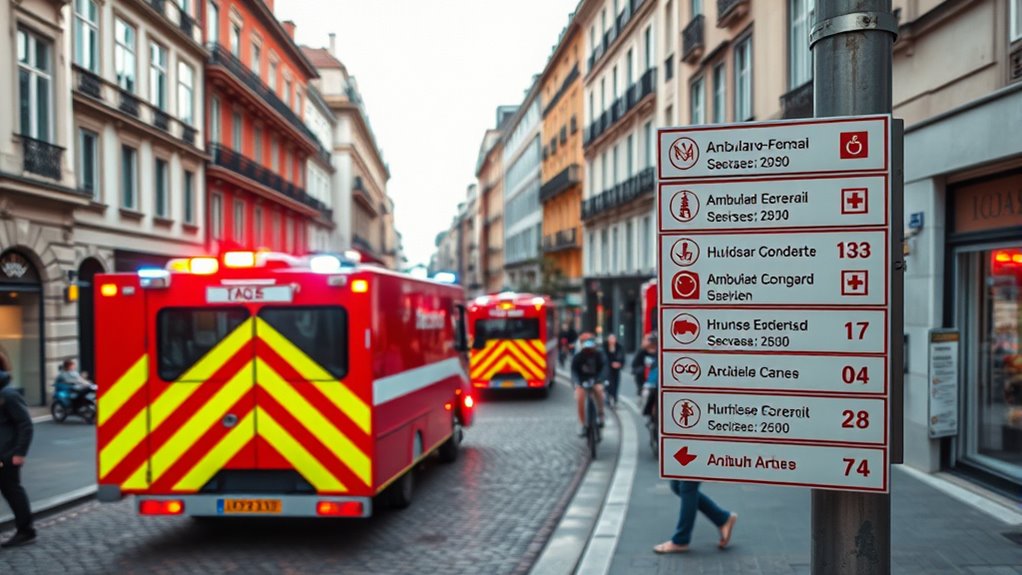
How do different countries in Europe handle emergency calls for ambulance and fire services? Many countries use the universal number 112, which connects you to both ambulance and fire services, available 24/7. For example, France has separate numbers: 15 for medical emergencies and 18 for fire. Germany uses 112 for both, while the UK offers 999 or 112 for all emergencies. In some nations, specific numbers are dedicated to fire or ambulance, such as Italy’s 112 covering all emergencies or Spain’s 112 alongside other local numbers like 062 for Guardia Civil. The system aims for quick access, with most countries providing free calls from mobile and landline phones. Familiarizing yourself with these local numbers guarantees you get help fast if an emergency occurs during your travels. Emergency contact systems vary across Europe, emphasizing the importance of knowing the correct numbers before traveling. Additionally, some countries have dedicated emergency services tailored to specific regions, which can be helpful to know in more remote areas. Moreover, public awareness campaigns are often conducted to ensure residents and visitors understand how to activate emergency services efficiently. Being aware of regional variations can further improve your response time in critical situations.
Unique Emergency Numbers in Non-EU Countries and the UK
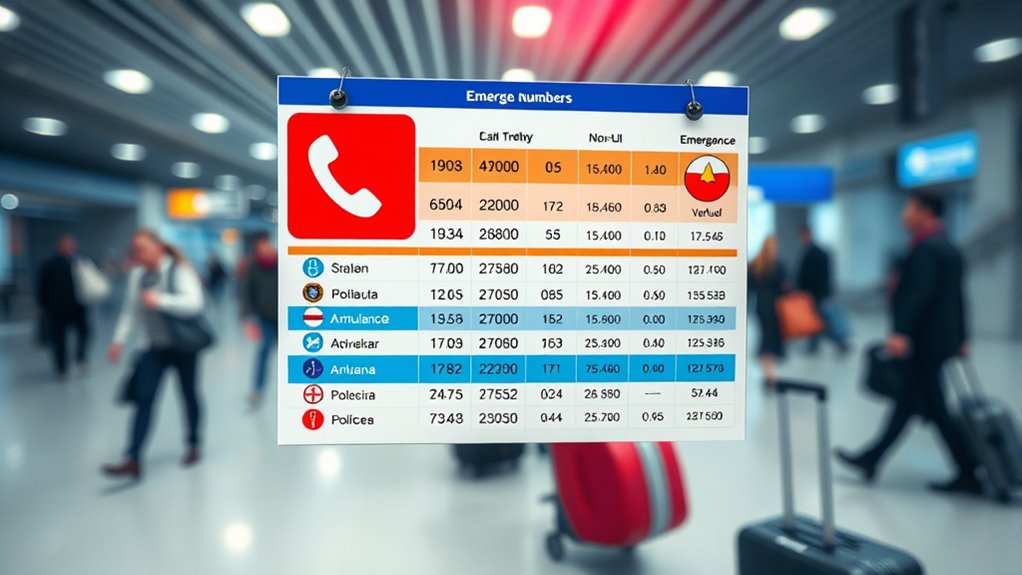
Outside the European Union, emergency numbers vary considerably, with many countries maintaining their own systems to guarantee rapid response. In the UK, you can dial 999 for any emergency or use 112, which works across Europe. Police numbers differ: 101 in England, Scotland, and Wales, and 112 in Northern Ireland. In Switzerland, 112 is general, but 117 is specifically for police, and 144 is for ambulance. Spain uses 112 for all emergencies, with additional local numbers like 091 for police. Italy consolidates emergencies on 112, including ambulance services. Poland’s numbers include 997 for police, 998 for fire, and 999 for ambulance, all redirecting to 112. Saving these country-specific numbers guarantees swift contact when needed. Understanding emergency systems can help travelers navigate unfamiliar situations more effectively.
To guarantee quick help during emergencies abroad, US travelers should save important local numbers before their trip. Start by programming the European emergency number 112 into your phone—it works from any phone without a country code and connects you instantly to police, fire, or medical services. Also, save country-specific numbers, like police or ambulance lines, especially in countries where 112 may not be the primary contact. Be aware that language barriers can delay assistance; in some places, local responders prefer specific numbers for faster service. Keep embassy contact details handy, such as the US embassy switchboard, for guidance or medical referrals in English. Having these numbers saved assures you’re prepared to act quickly, even if communication becomes challenging.
How 112 Connects You to Multiple Emergency Services Instantly

When you dial 112 in Europe, your call is automatically directed to a central emergency dispatch system that links you to police, fire, or medical services as needed. This system uses advanced technology to identify your location instantly and route your call accordingly. With one call, you don’t have to guess which number to dial for specific emergencies. The system guarantees quick access to help, saving valuable time during urgent situations.
- Connects you to police, fire, or medical services seamlessly
- Uses your location to send the right responders automatically
- Works from any phone, mobile or fixed, without country codes
Preparing for Your Trip: Saving Key Emergency Numbers on Your Phone
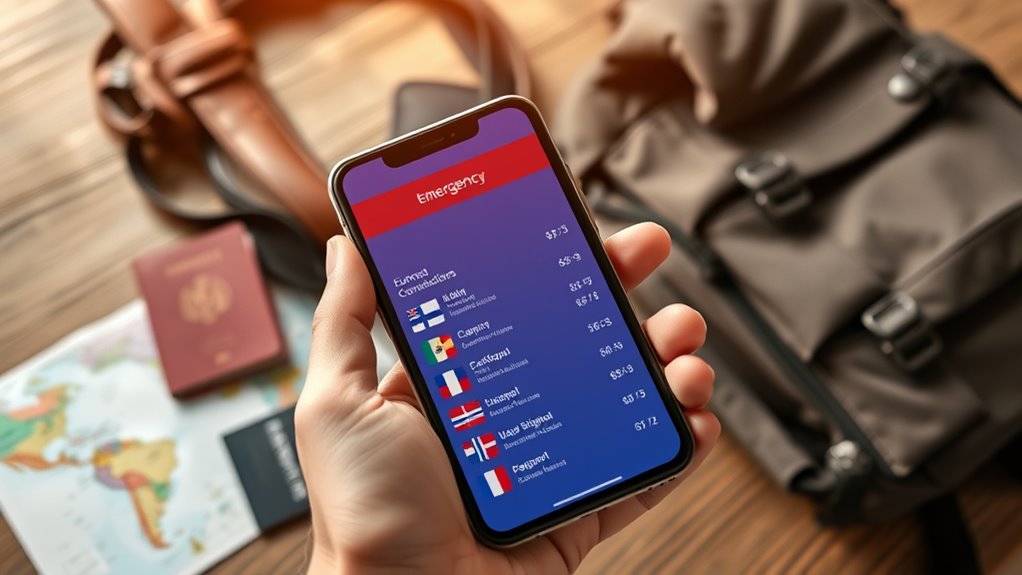
Before you travel to Europe, take a few minutes to save key emergency numbers on your phone. This guarantees quick access in any situation, saving precious time. Save the EU-wide number 112, which connects you to police, ambulance, and fire services across most countries. Also, note country-specific numbers like 101 in Belgium or 192 in Croatia for direct police contact. For emergencies requiring medical or fire assistance, remember numbers such as 15 in France or 112 across Europe. Keep a list of these numbers, including embassy contacts, in your phone for easy retrieval. To visualize, here’s a quick reference:
| Country | Police | Ambulance | Fire |
|---|---|---|---|
| France | 112/15 | 112 | 18 |
| Germany | 110 | 112 | 112 |
| UK | 999 | 111 | 999 |
| Italy | 112 | 112 | 112 |
| Spain | 112 | 062 | 092 |
Frequently Asked Questions
Can I Dial 112 From Any Mobile Phone Without an Internet Connection?
Ever wonder if you can reach help quickly in an emergency? Yes, you can dial 112 from any mobile phone without an internet connection. It’s a universal emergency number across Europe that works even if you have no signal or data. Just dial, and your call will connect to local emergency services. Keep this number saved before your trip—it’s your lifeline when you need it most.
Are Emergency Numbers the Same in All European Countries?
Emergency numbers aren’t the same in all European countries. While 112 is widely accepted across the EU and many neighboring nations, some countries have their own specific numbers for police, ambulance, or fire services. For example, the UK uses 999, and Spain has 091 or 062. It’s smart to save 112 as your primary emergency contact, but also note local numbers for quicker access if needed.
How Can I Get Language Assistance When Calling Emergency Services?
When calling emergency services in Europe, you might face language barriers. To get assistance in your language, dial your country’s embassy or consulate for help, or ask for an English-speaking operator if available. Keep important contact info handy, like embassy numbers. Using apps or translation tools can also help. Remember, emergency operators may speak limited English, so stay calm and be as clear as possible.
Is the 116000 Missing Children Hotline Available in Non-Eu Countries?
Yes, the 116000 missing children hotline is available in some non-EU countries, but it isn’t universal. You’ll need to check specific country services before traveling, as availability varies. It’s a case of “better safe than sorry,” so save local emergency numbers and the hotline, if available, on your phone. Knowing these can be a lifesaver, especially when you’re in unfamiliar territory trying to help or get help quickly.
Do I Need to Include a Country Code When Calling Emergency Numbers Abroad?
No, you don’t need to include a country code when calling emergency numbers abroad. Dial 112 or the local emergency number directly from your phone, and the call will connect to the appropriate local emergency services. This works even on roaming. Just remember, saving 112 as your primary emergency contact before traveling guarantees quick access, and keep in mind that some countries have specific numbers for police, ambulance, or fire services.
Conclusion
Make sure you save these important emergency numbers before your trip, so help is always just a call away. Did you know that over 90% of European countries use 112 as the universal emergency number? This simple step can save precious time in an emergency. By being prepared and aware of the right contacts, you’ll navigate any situation confidently and stay safe during your travels across Europe.